
Fruits, Berries & Vines
Grow your own berries, fruit trees, and grapes. Learn the difference between floricane and primocane berries, how to prune fruit trees for maximum production, and how to train grape vines for a bountiful harvest.
Understanding Cane Berries
Raspberries and blackberries grow on canes. Understanding cane types is essential for proper pruning.
- New cane emerging from roots this season
- Green, flexible, actively growing
- Primocane-fruiting varieties fruit on these in fall
- Overwinters to become a floricane next year
- Last year's primocane, now in its second season
- Brown, woody bark, more rigid
- Floricane-fruiting (summer-bearing) varieties fruit on these
- Dies after fruiting - remove at ground level
Summer-bearing (floricane): After harvest, cut brown spent canes to ground. In late winter, thin green canes.
Fall-bearing (primocane): Mow everything to 2-3 inches in late winter. Done!
Berry Growing Guide
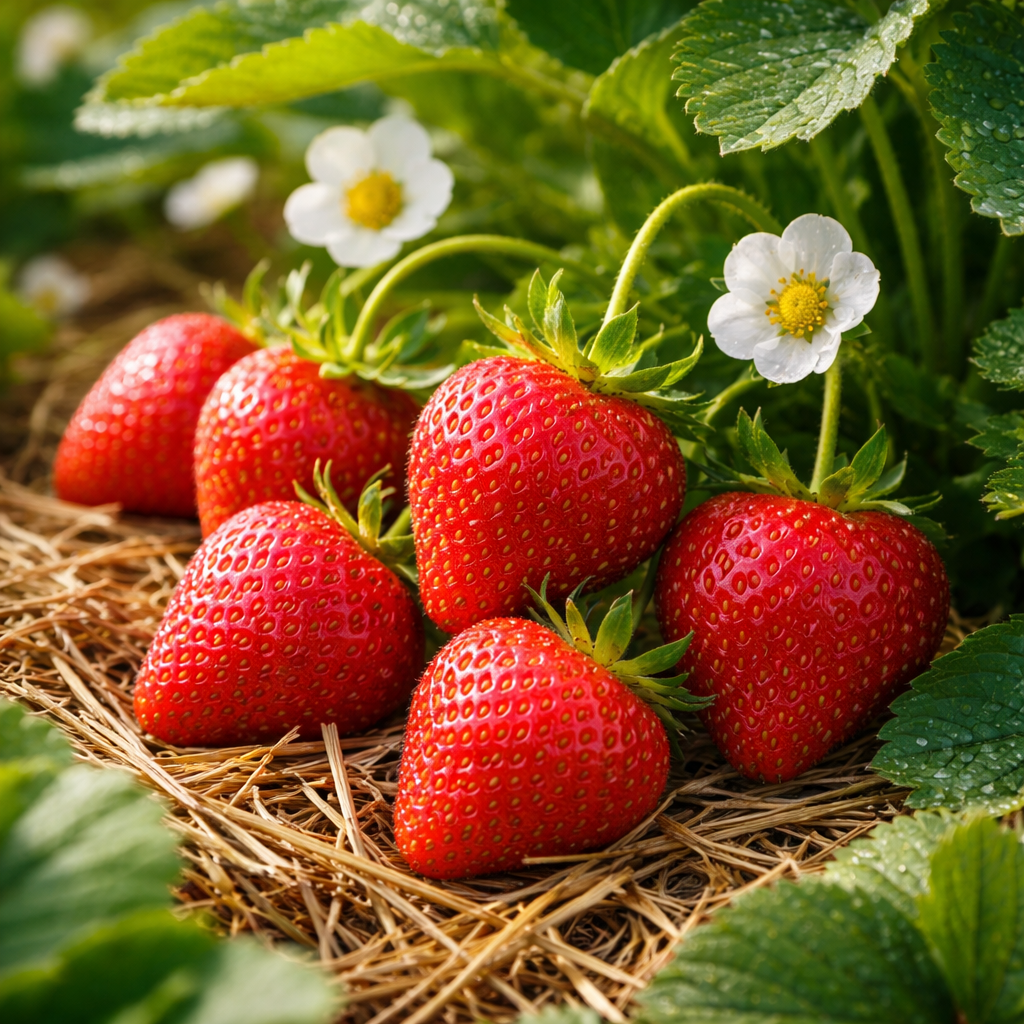
Spacing: 12-18 inches apart, rows 3-4 feet apart
Depth: Crown at soil level - critical! Too deep = rot, too shallow = dry out
Timing: Early spring (as soon as soil can be worked) or fall
Soil: Well-drained, slightly acidic (pH 5.5-6.8), rich in organic matter
Strawberries Types
Varieties: Chandler, Earliglow, Jewel, Honeoye
Pros:
- Biggest harvest at once
- Largest individual berries
- Best for jam/freezing
Cons:
- All-or-nothing harvest
- Runners need management
Varieties: Ozark Beauty, Quinault, Fort Laramie
Pros:
- Extended harvest
- Good for fresh eating
- Fewer runners
Cons:
- Smaller berries
- Lower total yield
Varieties: Seascape, Albion, Tristar, Tribute
Pros:
- Harvest all season
- Great for containers
- Minimal runners
Cons:
- Smallest berries
- Heat-sensitive above 85°F
- Remove flowers first year for June-bearing (builds stronger plants)
- Mulch with straw to keep berries clean and soil cool
- Water 1-2 inches weekly, especially during fruiting
- Renovate June-bearing beds after harvest: mow, thin, fertilize
- Replace plants every 3-4 years as vigor declines
Fruit Tree Basics
Understanding rootstocks, pollination, and pruning for successful fruit trees.
Fruit trees are grafted: the scion (top, fruit-bearing part) is attached to a rootstock (root system). The rootstock determines the tree's final size, when it starts fruiting, disease resistance, and anchoring needs.
Dwarf (6-10 ft)
Fruits earliest (year 2-3), needs permanent staking, shortest lived
Semi-Dwarf (12-18 ft)
Best for most home gardens, fruits year 3-4, free-standing
Standard (20-30 ft)
Longest lived (100+ years), fruits year 5-8, needs ladder
Common Rootstocks
Pollination
Most need a different variety for cross-pollination. Crabapples work.
Pruning
Central leader or modified central leader. Prune in late winter.
Chill Hours
500-1200 depending on variety
Common Issues
Common Rootstocks
Pollination
Need cross-pollination. Seckel and Bartlett are NOT compatible.
Pruning
Central leader. Light pruning - heavy pruning stimulates fire blight-susceptible growth.
Chill Hours
400-900 depending on variety
Common Issues
Common Rootstocks
Pollination
Peaches/nectarines mostly self-fertile. Sweet cherries need cross-pollination. Plums vary.
Pruning
Open vase/center (no central leader). Aggressive annual pruning needed, especially peaches.
Chill Hours
Varies widely: peaches 400-1000, cherries 500-1400
Common Issues
Fruit Tree Training Shapes
One dominant vertical trunk with horizontal scaffold branches at intervals.
How to Train:
- 1Select strongest upright shoot as leader
- 2Choose 3-4 scaffold branches spaced 6-8 inches vertically, spiraling around trunk
- 3Remove competing leaders and branches with narrow crotch angles
- 4Keep scaffold branches shorter than leader
No central leader. 3-5 main branches form open bowl shape for light penetration.
How to Train:
- 1At planting, head back to 24-30 inches
- 2Select 3-5 well-spaced scaffold branches
- 3Remove central leader to open up center
- 4Keep center open annually - stone fruits fruit on new wood
Trained flat against wall or fence. Space-saving, ornamental, and practical.
How to Train:
- 1Plant 6-12 inches from wall
- 2Install horizontal wires at 18-inch intervals
- 3Train branches along wires, remove anything growing outward
- 4Summer prune to maintain shape
Growing Grapes
Grape vines can produce for 50+ years with proper care. Choose the right type for your climate and use.
Varieties: Concord, Niagara, Catawba, Delaware
Flavor: Strong "grapey" flavor, slip-skin
Uses: Juice, Jelly, Fresh eating, Wine
Hardiness: Very cold hardy (-20°F or colder)
Disease Resistance: Resistant to most grape diseases
Varieties: Thompson Seedless, Flame, Chardonnay, Cabernet
Flavor: Classic wine grape and table grape flavor
Uses: Wine, Table grapes, Raisins
Hardiness: Less cold hardy (0-10°F)
Disease Resistance: Susceptible to many diseases, needs spraying
Varieties: Marquette, Frontenac, La Crescent, Chambourcin
Flavor: Wine-quality flavor with better hardiness
Uses: Wine, Some fresh eating
Hardiness: Good cold hardiness (-20 to -30°F)
Disease Resistance: Good disease resistance
Varieties: Scuppernong, Carlos, Noble, Triumph
Flavor: Unique musky, sweet flavor
Uses: Fresh eating, Wine, Juice, Jelly
Hardiness: Heat-loving, not cold hardy (Zone 7+)
Disease Resistance: Extremely disease resistant
Four-Arm Kniffin
Simple system with two wires. Good for American grapes and beginners.
Setup: Two wires at 3 and 6 feet. Train 4 canes (2 per wire) in opposite directions.
High Cordon
Permanent horizontal arms (cordons) with fruiting canes hanging down.
Setup: Single wire at 6 feet. Train permanent cordons, spurs produce fruit.
VSP (Vertical Shoot Positioning)
Professional system for vinifera. Shoots trained upward between wires.
Setup: 3-4 wires, shoots grow up between catch wires. Most labor intensive.
- Grapes fruit on NEW growth arising from LAST YEAR's wood
- Remove 80-90% of previous year's growth - yes, really!
- Leave 40-60 buds total for mature vine
- Spur pruning: Leave 2-3 bud spurs on permanent cordons
- Cane pruning: Select pencil-thick canes with 8-12 buds
Propagation Methods
Multiply your berry bushes, grape vines, and fruit trees using these proven techniques.