
Permaculture & Sustainable Gardening
Design gardens that work with nature, not against it. Learn food forest principles, companion planting guilds, water harvesting, and regenerative techniques that build soil and ecosystem health year after year.
12 Permaculture Principles
The foundation of permaculture design, developed by David Holmgren and Bill Mollison.
Observe & Interact
Take time to engage with nature before making changes. Observe patterns, sun, water, wind.
Catch & Store Energy
Capture resources (water, sun, nutrients) when abundant for use in times of need.
Obtain a Yield
Ensure you get useful rewards from your work - food, resources, or ecosystem services.
Self-Regulation
Discourage inappropriate activity and accept feedback to self-correct.
Reduce Waste
Value and make use of all resources. There is no waste in nature.
Design from Patterns
Observe patterns in nature and society. Use them in design.
Integrate Rather Than Segregate
Place elements so they assist each other. Stack functions.
Small & Slow Solutions
Small, slow systems are easier to maintain and make better use of resources.
Diversity
Diversity reduces vulnerability to threats and takes advantage of unique environments.
Use Edges
The interface between things is where the most activity occurs.
Use & Value Change
Make creative use of change by observing and intervening at the right time.
Earth Care
Provision for all life systems to continue and multiply.
7 Layers of the Food Forest
A food forest mimics natural forest ecosystems, stacking edible plants in vertical layers to maximize production in minimal space.
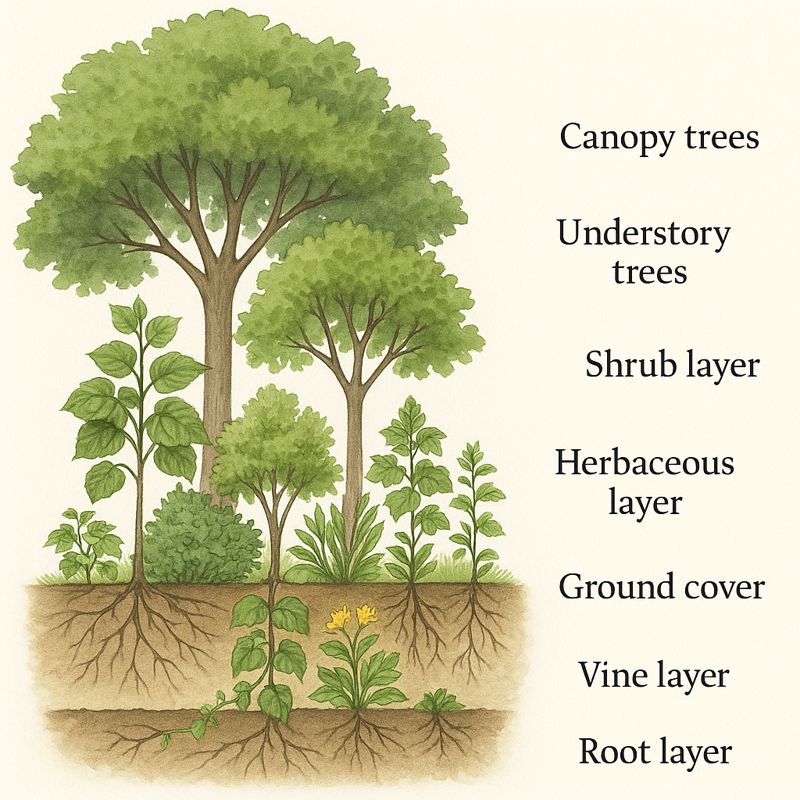
The 7 layers of a food forest work together to create a productive, self-sustaining ecosystem
Canopy Layer
30-60+ ftLarge fruit and nut trees that form the top layer
Understory Trees
10-30 ftSmaller trees that tolerate partial shade
Shrub Layer
4-10 ftBerry bushes and other fruiting shrubs
Herbaceous Layer
1-4 ftPerennial vegetables, herbs, and beneficial plants
Ground Cover
0-1 ftLow-growing plants that protect soil and suppress weeds
Vine Layer
VariableClimbing plants that use vertical space
Root Layer
UndergroundRoot vegetables and tubers
Companion Planting Guilds
Guilds are groups of plants that support each other through nutrient cycling, pest control, pollination, and other symbiotic relationships.
- Comfrey - Dynamic accumulator - brings up nutrients
- White Clover - Nitrogen fixer - adds fertility
- Daffodils - Pest deterrent - repels borers
- Chives - Pest deterrent - repels aphids & scab
- Nasturtiums - Trap crop - attracts aphids away
- Fennel - Beneficial insect attractor
- Corn - Structure - provides trellis for beans
- Pole Beans - Nitrogen fixer - feeds corn and squash
- Winter Squash - Living mulch - shades soil, deters pests
- Basil - Pest deterrent - repels flies, improves flavor
- Carrots - Loosens soil, different root zone
- Marigolds - Pest deterrent - repels nematodes
- Parsley - Attracts beneficial wasps
- Borage - Attracts pollinators, deters hornworms
Key Techniques
Practical methods to build soil, conserve water, and work with nature.
Build soil by layering organic materials directly on existing ground. No digging required.
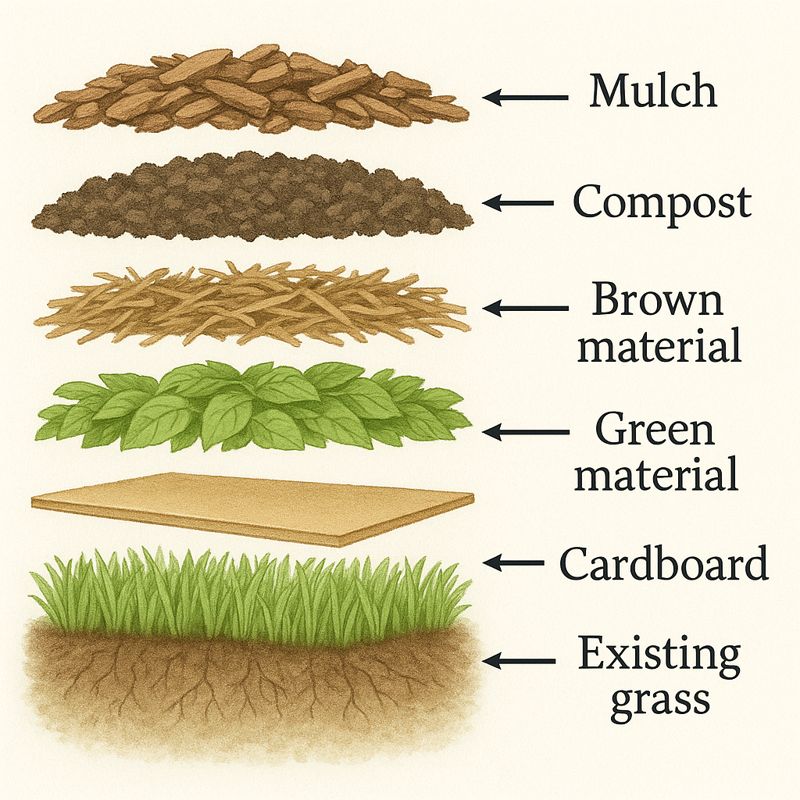
Layer materials in this order to create rich, weed-free soil
Step-by-Step:
- 1Mow or stomp down existing vegetation
- 2Add thin layer of compost or manure
- 3Cover with overlapping cardboard or newspaper (wet first)
- 4Add 4-6" of nitrogen-rich "green" materials (grass clippings, food scraps)
- 5Top with 4-8" of carbon-rich "brown" materials (straw, leaves, wood chips)
- 6Water thoroughly and let sit 3-6 months (or plant directly in compost pockets)
Benefits:
Attracting Beneficial Insects
Create habitat for predatory insects that control pests naturally.
| Beneficial | Prey/Pests Controlled | Plants to Attract Them |
|---|---|---|
Ladybugs | Aphids, mites, scale | Dill, fennel, yarrow, tansy |
Lacewings | Aphids, thrips, mealybugs | Coreopsis, cosmos, dill, angelica |
Hoverflies | Aphids (larvae) | Alyssum, dill, fennel, coriander |
Parasitic Wasps | Caterpillars, aphids | Dill, fennel, yarrow, Queen Anne's lace |
Ground Beetles | Slugs, snails, cutworms | Perennial beds, mulch, ground cover |
Praying Mantis | Many garden pests | Tall grasses, shrubs, dill |
Leave some areas "messy" with leaf litter and brush piles - these provide overwintering habitat for beneficial insects.
Getting Started with Permaculture
Observe First
Spend at least one full season observing your space before making major changes. Note sun patterns, water flow, wind, and existing wildlife.
Start Small
Begin with one guild or one sheet-mulched bed. Learn from small experiments before scaling up.
Build Soil
Focus on soil health first. Use sheet mulching, no-dig methods, and compost to create living soil.
Stack Functions
Choose plants that serve multiple purposes: food, medicine, pollinator support, nitrogen fixing.
Think Long-Term
Plant perennials and trees that will produce for decades. Balance immediate yields with long-term investment.