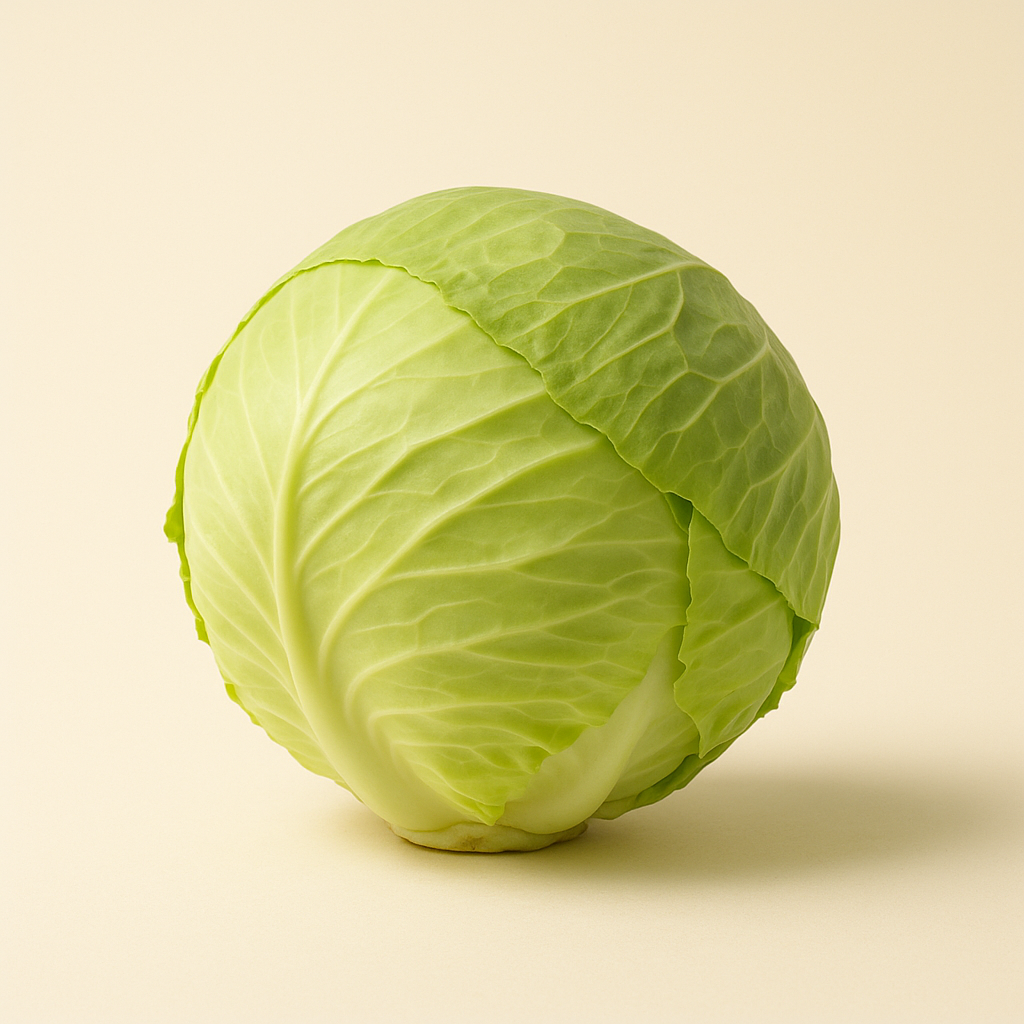
Cabbage
Brassica oleracea var. capitata
Family: Brassicaceae
Cabbage is a cold-hardy vegetable that forms tight heads of layered leaves. One of the oldest cultivated vegetables, cabbage is incredibly versatile and stores for months. From coleslaw to sauerkraut to stir-fries, cabbage is a kitchen staple.
Days to Harvest
60-180 days
Sun Needs
Full Sun (6+ hours)
high
Germination Temp
70°F optimal
Start Indoors
6 weeks before last frost
Germination
4-10 days
Seed Depth
1/4 to 1/2 inch
Light to Germinate
No
💡 Tip: Start indoors for spring crop. For fall crop, start in mid-summer. Harden off thoroughly before transplanting.
Soil Type
Rich, well-draining soil with plenty of organic matter
pH Range
6 - 7.5
Spacing
12-18 inches between plants depending on head size desired
⚠️ Avoid planting near:
History
Cabbage's story is inseparable from European history, serving as a survival food that sustained civilizations through harsh winters, long sea voyages, and times of scarcity for over 4,000 years. Wild cabbage (Brassica oleracea) grows naturally along the chalk cliffs of the European Atlantic coast, and early cultivation likely began with Celtic peoples who brought the vegetable across the continent. Ancient Greeks believed cabbage had medicinal properties—Cato the Elder wrote extensively about its curative powers—and Greek physicians recommended it as a remedy for nearly everything from drunkenness to plague. The Romans adopted cabbage enthusiastically, developing early heading varieties and spreading cultivation throughout their empire. Medieval European peasants depended on cabbage for winter survival, fermenting it into sauerkraut to preserve the vitamin C content that prevented scurvy. This fermented cabbage became crucial for explorers: Captain James Cook credited sauerkraut with keeping his sailors healthy during long Pacific voyages, and German immigrants brought sauerkraut culture to America, establishing cabbage as a foundational crop. Korean kimchi, developed independently from Chinese cabbage varieties, represents another great fermented cabbage tradition. Cabbage accompanied nearly every wave of European immigration to America—Irish colcannon, German sauerkraut, Polish golabki (stuffed cabbage), and Russian borscht all crossed the Atlantic with their respective communities. The "cabbage patch" became synonymous with humble beginnings, yet the vegetable's role in human nutrition and survival is anything but humble. Today, China produces more than half the world's cabbage, and the vegetable remains essential to cuisines from Korea to Brazil.
Nutritional Benefits
- ✓High in Vitamin C
- ✓Good source of Vitamin K
- ✓Contains fiber
Optimal Growing Temp
60°F - 70°F
Cabbage thrives in cool temperatures between 60-70°F. Can tolerate light frosts and even temperatures near freezing once established. Growth slows above 80°F and heads may split in heat.
Survival Range
38°F - 80°F
Can survive these temperatures
Frost Note: Mature cabbage is very frost-tolerant, surviving temperatures down to 20°F. Frost actually improves flavor by converting starches to sugars. Young transplants need protection from hard freezes.
Best USDA Zones
Humidity
50-70%
Moderate humidity is ideal. High humidity combined with poor air circulation increases risk of fungal diseases like black rot and downy mildew.
Height
12-18 inches
Spread
18-24 inches
Growth Habit
upright
Germination
4-10 days
Seeds germinate at 45-85°F, with optimal temperature of 70°F. Cotyledon leaves emerge within a week under ideal conditions.
Seedling Stage
Duration: 4-6 weeks
True leaves: First true leaves appear 7-10 days after sprouting with characteristic cabbage shape
Transplant ready: Ready to transplant when 4-6 inches tall with 4-5 true leaves. Harden off for 7-10 days before outdoor transplanting.
Vegetative Growth
Duration: 6-10 weeks after transplant
Cabbage develops a rosette of outer leaves that capture sunlight and feed the developing head. This stage is critical for building the leaf mass that will eventually form the tight head.
Harvest Maturity
Timing: 60-180 days from transplant depending on variety
- Head is firm and solid when squeezed
- Head has reached expected size for variety
- Outer wrapper leaves may begin to yellow slightly
- Head feels dense and heavy for its size
Per Plant
2-8 lbs per head depending on variety
Per Square Foot
1-2 lbs per square foot with proper spacing
Harvest Frequency
One head per plant. Early varieties may produce small secondary heads if stump is left.
Factors Affecting Yield
- •Cool temperatures during heading produce tighter, larger heads
- •Consistent moisture prevents splitting and promotes solid heads
- •Adequate spacing allows for larger head development
- •Variety selection - early varieties produce smaller heads, storage varieties produce larger heads
- •Soil fertility - heavy feeders need rich soil for maximum size
- •Timing - fall crops often produce better quality than spring crops
Seedling Stage
Keep consistently moist, water daily in warm weather
Established Plants
1-2 inches per week, deep watering every 3-5 days
During Fruiting
Critical to maintain even moisture during heading - fluctuations cause splitting
Preferred Method
Drip irrigation or soaker hoses preferred. Water at soil level to keep foliage dry. Deep, infrequent watering better than frequent shallow watering.
⚠️ Critical Watering Periods
- • Head formation
- • Head maturation
Pro Tips
- Mulch heavily (3-4 inches) to maintain consistent moisture
- Never let plants completely dry out during heading
- Reduce watering slightly as heads near maturity to prevent splitting
- In rainy periods, twist plant to break some roots and slow water uptake
Feeding Schedule
At Transplanting
Balanced fertilizer with compost
Once at planting
Vegetative Growth
High nitrogen (10-6-4 or blood meal)
Every 3-4 weeks
Head Formation
Balanced (10-10-10)
Every 3-4 weeks
Head Maturation
Reduce feeding 3-4 weeks before harvest
Stop fertilizing
Organic Options
Side-dress with compost every 3-4 weeks. Apply blood meal or fish emulsion for nitrogen boost. Add lime if soil pH is low.
Minimum Size
5 gallon minimum
Recommended Size
10-15 gallon for full-sized heads, 3-5 gallon for mini varieties
Depth Required
At least 12 inches deep
Best Varieties for Containers
Container Tips
- Choose compact varieties like Golden Acre or Early Jersey Wakefield
- Use rich potting mix amended with compost
- Containers need daily watering in warm weather
- Feed every 2-3 weeks with balanced liquid fertilizer
- Position where plants receive full sun in spring/fall
Plant Every
2-3 weeks
Sowings/Season
2-3 varieties (early, mid-season, storage) for extended harvest
Duration
Spring: start 6-8 weeks before last frost. Fall: start in mid-summer
Tips
- Plant early, mid-season, and late varieties all at once for staggered harvest
- Or succession plant same variety every 2-3 weeks
- Fall crops are easier and produce better quality in most climates
- In mild climates, can plant late summer through fall for winter/spring harvest