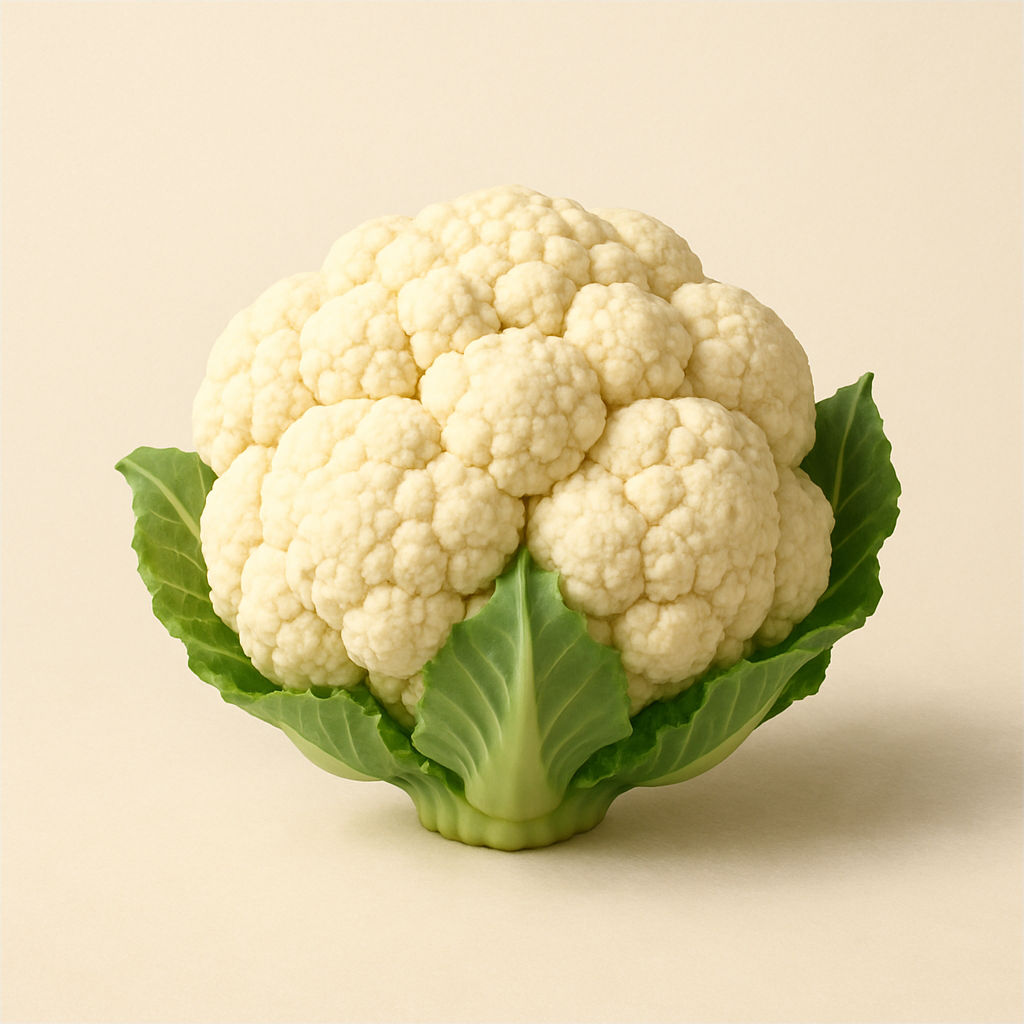
Cauliflower
Brassica oleracea var. botrytis
Family: Brassicaceae
Cauliflower is a cool-season crop that produces dense, creamy white heads (curds) prized for their mild, nutty flavor. More challenging than broccoli, cauliflower rewards careful attention with beautiful, tender heads. Colorful varieties add visual interest.
Days to Harvest
55-100 days
Sun Needs
Full Sun (6+ hours)
high
Germination Temp
70°F optimal
Start Indoors
6 weeks before last frost
Germination
4-10 days
Seed Depth
1/4 to 1/2 inch
Light to Germinate
No
💡 Tip: Cauliflower is sensitive to stress. Harden off carefully. Avoid transplant shock by keeping roots intact.
Soil Type
Rich, moisture-retentive soil with excellent drainage
pH Range
6.5 - 7.5
Spacing
18-24 inches between plants, 30-36 inches between rows
⚠️ Avoid planting near:
History
Cauliflower represents the aristocrat of the brassica family—delicate, demanding, and historically reserved for the tables of the wealthy. The vegetable likely developed in Cyprus or the eastern Mediterranean around the 6th century CE, with Arab traders spreading it across the Middle East and eventually to Italy and France by the 16th century. Its name derives from the Latin "caulis" (cabbage) and "floris" (flower), describing its essential nature as an edible flower head. The 12th-century Arab botanist Ibn al-Awwam described three cauliflower varieties in his agricultural treatise, and the Moors brought it to Spain during their occupation. French king Louis XIV's famous gardener Jean de La Quintinie cultivated cauliflower for the royal table, and the vegetable remained a luxury item for centuries—its cultivation demands precise temperature control, abundant water, and nutrient-rich soil that made it unsuitable for peasant gardens. Mark Twain's famous quip that cauliflower is "nothing but cabbage with a college education" captures its reputation for refinement and difficulty. The development of self-blanching varieties in the 20th century simplified cultivation by eliminating the traditional practice of tying leaves over the developing head to keep it white. The low-carb diet revolution of the 2000s transformed cauliflower's culinary status—suddenly it became a versatile substitute for everything from rice to pizza crust to mashed potatoes. Colorful varieties (orange Cheddar with enhanced beta-carotene, purple Graffiti with anthocyanins, and green Romanesco with its mathematical fractal spirals) have expanded cauliflower's appeal beyond its traditional white presentation.
Nutritional Benefits
- ✓High in Vitamin C
- ✓Good source of Vitamin K
- ✓Contains fiber
Optimal Growing Temp
60°F - 70°F
Cauliflower is the most temperature-sensitive brassica, thriving in a narrow range of 60-70°F. Temperatures above 75°F cause heads to become loose, ricey, or fail to form entirely. Plants tolerate light frosts but curd quality suffers from repeated freeze-thaw cycles.
Survival Range
40°F - 80°F
Can survive these temperatures
Frost Note: Cauliflower tolerates light frosts down to 25°F but is less cold-hardy than cabbage or broccoli. Curds (the edible heads) can be damaged by hard frosts, causing brown spots and off-flavors. Protect forming heads with floating row covers during cold snaps.
Best USDA Zones
Humidity
50-70%
Moderate humidity is best. High humidity increases fungal disease risk, especially during blanching when leaves cover the curd. Ensure good air circulation around plants.
Height
18-24 inches
Spread
18-24 inches
Growth Habit
upright
Germination
4-10 days
Seeds germinate best at 65-75°F. Cotyledons (seed leaves) emerge first, followed by true leaves with the characteristic cabbage-family shape.
Seedling Stage
Duration: 4-6 weeks
True leaves: First true leaves appear 7-10 days after sprouting, developing the typical blue-green brassica color
Transplant ready: Ready to transplant when 4-5 inches tall with 4-6 true leaves. Harden off gradually over 7-10 days before transplanting.
Vegetative Growth
Duration: 4-6 weeks after transplant
Rapid leaf development creates the large canopy needed to support curd formation. Plants need consistent conditions during this critical phase—stress now affects head quality later.
Flowering
Timing: 8-12 weeks after transplant depending on variety
Duration: Curd forms over 10-14 days
The edible curd is actually compressed, immature flower buds. If not harvested, the curd will elongate and open into yellow flowers.
Harvest Maturity
Timing: 55-100 days from transplant depending on variety
- Curd reaches 6-8 inches in diameter (or variety-appropriate size)
- Curd is compact, firm, and tight
- Surface is smooth without riciness or fuzziness
- Color is white, cream, or appropriate variety color
- No yellowing, browning, or spreading of curd sections
Per Plant
1.5-3 lbs per head depending on variety
Per Square Foot
1-2 lbs per square foot
Harvest Frequency
One head per plant (unlike broccoli, cauliflower rarely produces side shoots)
Factors Affecting Yield
- •Temperature consistency is the most critical factor—fluctuations ruin curds
- •Proper blanching produces whiter, milder-flavored heads
- •Adequate nutrients, especially boron and molybdenum, prevent brown curds
- •Consistent moisture prevents buttoning (premature small heads)
- •Variety selection must match your climate and season
- •Self-blanching varieties are more forgiving for beginners
Seedling Stage
Keep consistently moist but not waterlogged—water daily if needed
Established Plants
1-1.5 inches per week, maintaining consistent soil moisture
During Fruiting
Critical to maintain even moisture during curd formation—stress causes buttoning
Preferred Method
Drip irrigation or soaker hoses are ideal. Water at soil level to keep foliage dry. Deep, even watering is more important for cauliflower than any other brassica.
⚠️ Critical Watering Periods
- • Curd formation
- • Hot weather
Pro Tips
- Cauliflower is less forgiving of water stress than other brassicas
- Mulch heavily to maintain consistent soil moisture
- Water stress during curd formation ruins the harvest
- Morning watering reduces disease risk
Feeding Schedule
At Transplanting
Balanced fertilizer with compost and trace minerals
Once at planting
Vegetative Growth
High nitrogen (10-5-5 or blood meal)
Every 2-3 weeks
Pre-Curd Formation
Balanced fertilizer with boron supplement
Once when wrapper leaves begin forming
Curd Formation
Light feeding of balanced fertilizer
Every 3 weeks
Organic Options
Side-dress with compost every 3 weeks. Kelp meal provides trace minerals including boron. Fish emulsion gives quick nitrogen boost. Apply boron as a foliar spray if deficiency symptoms appear.
Minimum Size
5 gallon minimum
Recommended Size
10-15 gallon for full-sized heads
Depth Required
At least 12 inches deep, 18 inches preferred for stability
Best Varieties for Containers
Container Tips
- Choose smaller or self-blanching varieties for container success
- Use high-quality potting mix enriched with compost
- Container soil temperatures fluctuate more—this challenges cauliflower
- Position containers where they receive morning sun and afternoon shade in warm weather
- Water consistently—containers dry out faster than garden beds
- Feed every 2 weeks with balanced liquid fertilizer
Why Prune
When
When curd reaches 2-3 inches diameter for blanching
How Often
Blanching is done once per plant. Self-blanching varieties wrap naturally.
Technique
Traditional blanching: gather outer leaves over the curd and secure with twine or rubber band. This blocks sunlight to keep curds white and mild-flavored.
Remove
- ✗ Yellowed or diseased lower leaves
- ✗ Leaves damaged by pests
Keep
- ✓ All healthy wrapper leaves—they protect and blanch the curd
- ✓ The growing point and emerging curd
Plant Every
2-3 weeks
Sowings/Season
2-3 plantings for extended harvest
Duration
For spring: start 8-10 weeks before last frost. For fall: start 12-14 weeks before first frost
Tips
- Fall crops are more reliable than spring crops for most gardeners
- Stagger plantings to spread harvest and reduce the all-at-once glut
- Choose varieties with different maturity dates for natural succession
- In mild climates, plant for winter harvest