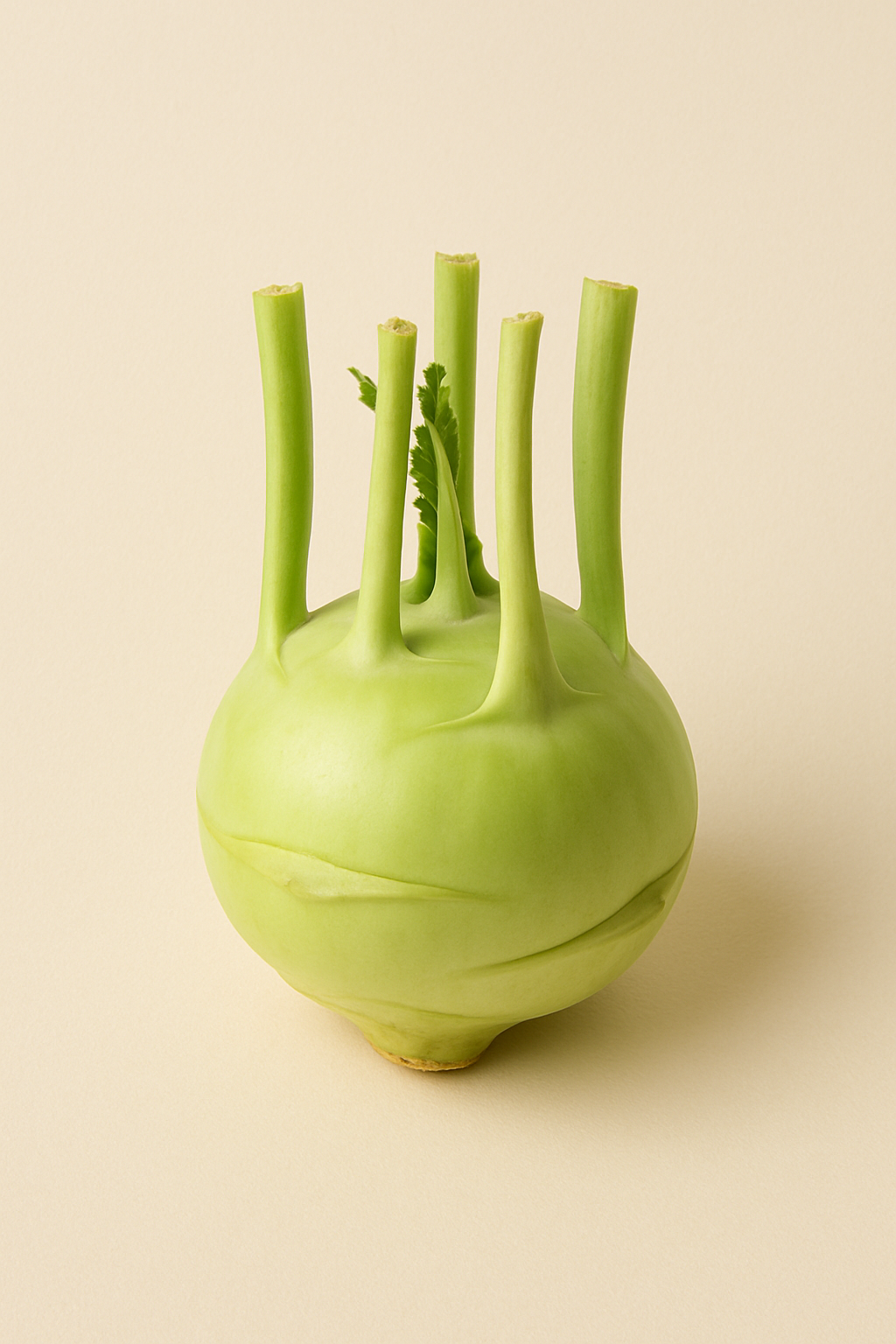
Kohlrabi
Brassica oleracea var. gongylodes
Family: Brassicaceae
Kohlrabi is an unusual vegetable forming a swollen stem above ground that looks like a space ship. The crisp, mild flesh tastes like a cross between cabbage and broccoli stems. Fast-growing and easy, it's perfect for new gardeners wanting something different.
Days to Harvest
45-80 days
Sun Needs
Full Sun to Partial Shade (6+ hours)
moderate
Germination Temp
70°F optimal
Start Indoors
4 weeks before last frost
Germination
3-10 days
Seed Depth
1/4 to 1/2 inch
Light to Germinate
No
💡 Tip: Direct sow works well. Very fast growing—can direct sow in both spring and late summer for two crops.
Soil Type
Well-draining, fertile soil
pH Range
6 - 7.5
Spacing
4-6 inches between plants, 12 inches between rows
⚠️ Avoid planting near:
History
Kohlrabi is one of agriculture's strangest-looking vegetables—a bulbous, alien-spacecraft-like swelling that forms above ground on the stem rather than underground like most root vegetables. First documented in northern Europe around 1554, kohlrabi was likely developed from wild cabbage in the Germanic regions where it remains most popular today. The name combines the German words "kohl" (cabbage) and "rabi" (turnip), perfectly describing its flavor profile and appearance. By the late 1500s, kohlrabi had spread throughout Europe, with Castelvetro mentioning it in 1614 as popular in Italy, Germany, and Spain. However, it never gained the same widespread adoption as its brassica relatives—perhaps because its space-age appearance intimidated home cooks unfamiliar with preparation. In Central and Eastern European cuisines, kohlrabi has remained a staple: Germans slice it raw for snacking, Hungarians add it to soups and stews, and Vietnamese cuisine (introduced via French colonialism) features it in su hào xào (stir-fried kohlrabi). The vegetable gained modest popularity in America through German immigrant communities, but remains relatively unknown compared to broccoli or cabbage. Kashmir cuisine particularly prizes kohlrabi, featuring it in dishes like monje haakh (kohlrabi greens) and Kashmiri dum monji (stuffed kohlrabi). Modern breeding has produced giant varieties like Kossak that can grow to 8-10 inches diameter while remaining tender—addressing the common complaint that standard varieties become woody if harvested late. Kohlrabi's recent resurgence comes from its versatility: eaten raw like an apple, spiralized into noodles, or roasted like turnips, it offers a mild, sweet, cruciferous flavor without the bitterness some find in broccoli or cabbage.
Nutritional Benefits
- ✓High in Vitamin C
- ✓Good source of fiber
- ✓Contains potassium
Optimal Growing Temp
60°F - 70°F
Kohlrabi thrives in cool weather between 60-70°F. Growth is rapid in ideal conditions, with bulbs forming in just 45-60 days. Plants tolerate light frosts and brief heat spells, making them more adaptable than many brassicas.
Survival Range
40°F - 80°F
Can survive these temperatures
Frost Note: Kohlrabi is moderately frost-tolerant, surviving temperatures down to 25°F once established. Light frosts improve sweetness slightly. Spring plantings tolerate cold better than they tolerate summer heat.
Best USDA Zones
Humidity
50-70%
Kohlrabi tolerates a range of humidity levels. Good air circulation helps prevent fungal issues. Less susceptible to humidity-related problems than leafier brassicas.
Height
12-18 inches
Spread
8-12 inches
Growth Habit
upright
Germination
3-10 days
Seeds germinate quickly at 45-85°F, with optimal germination around 70°F. Kohlrabi is one of the fastest-germinating brassicas.
Seedling Stage
Duration: 3-4 weeks
True leaves: First true leaves appear 7-10 days after sprouting with typical brassica leaf shape
Transplant ready: Ready to transplant when 3-4 inches tall with 3-4 true leaves. Can direct sow for simplicity.
Vegetative Growth
Duration: 3-5 weeks
Rapid leaf and stem development. The stem begins to swell above ground, forming the characteristic bulb. Growth is very fast with proper moisture and nutrients.
Flowering
Timing: Bolts in second year or under stress (heat, drought)
Duration: N/A for vegetable harvest—harvest before bolting
Plants bolt and produce yellow flowers if exposed to prolonged cold followed by warm temperatures, or in hot weather.
Harvest Maturity
Timing: 45-80 days from seed depending on variety
- Bulb reaches 2-3 inches diameter (standard) or 4-10 inches (giant varieties)
- Bulb is firm and smooth when pressed
- Skin is tight and not cracked
- Leaves are still green and healthy
- Harvest before bulb becomes woody
Per Plant
0.25-0.5 lb per bulb (standard) or 2-4 lbs (giant varieties)
Per Square Foot
0.5-1 lb per square foot due to close spacing
Harvest Frequency
One bulb per plant, but fast maturity allows multiple succession plantings
Factors Affecting Yield
- •Consistent moisture produces tender, crisp bulbs
- •Harvest timing is critical—oversize standard varieties become woody
- •Giant varieties stay tender at larger sizes
- •Cool weather produces sweetest, most tender bulbs
- •Succession planting extends harvest season
Seedling Stage
Keep consistently moist—water daily in warm weather
Established Plants
1 inch per week, maintaining even soil moisture
During Fruiting
Consistent moisture during bulb formation prevents woody texture
Preferred Method
Water at soil level with drip irrigation or soaker hoses. Kohlrabi tolerates various watering methods but consistency is key.
⚠️ Critical Watering Periods
- • Bulb formation
- • Hot weather
Pro Tips
- Even moisture is the key to tender, mild-flavored kohlrabi
- Mulch to maintain consistent soil moisture
- Water stress causes woody texture—the main quality problem
- Morning watering is best
Feeding Schedule
At Planting
Balanced fertilizer worked into soil
Once at planting
Mid-Growth
Side-dress with balanced fertilizer
Once, about 3 weeks after planting
Organic Options
Work compost into soil before planting. Side-dress with fish emulsion once during growth if needed. Kohlrabi is not a heavy feeder.
Minimum Size
3 gallon minimum
Recommended Size
5 gallon, or multiple plants in a wide container
Depth Required
At least 8 inches deep—kohlrabi has shallow roots
Best Varieties for Containers
Container Tips
- Excellent container vegetable due to small size and fast growth
- Space plants 4-6 inches apart in wide containers
- Use quality potting mix—kohlrabi is unfussy about soil
- Water consistently to prevent woody texture
- Full sun is ideal; tolerates partial shade
- Perfect for windowsill or balcony gardening
Why Prune
When
As needed throughout the growing season
How Often
Rarely needed—kohlrabi grows too fast for extensive pruning
Technique
Simply remove any yellowed, damaged, or pest-eaten leaves at the base.
Remove
- ✗ Yellowed or damaged leaves
- ✗ Pest-damaged foliage
Keep
- ✓ All healthy leaves—they feed the bulb
- ✓ The developing bulb and growing point
Plant Every
2-3 weeks
Sowings/Season
3-5 plantings for continuous harvest
Duration
Spring: from 4 weeks before last frost to 6 weeks after. Fall: 8-10 weeks before first frost
Tips
- Fast maturity makes kohlrabi ideal for succession planting
- Sow every 2-3 weeks for continuous harvest
- Skip succession during hottest part of summer
- Both spring and fall crops work well in most regions
- Can interplant with slower crops like tomatoes