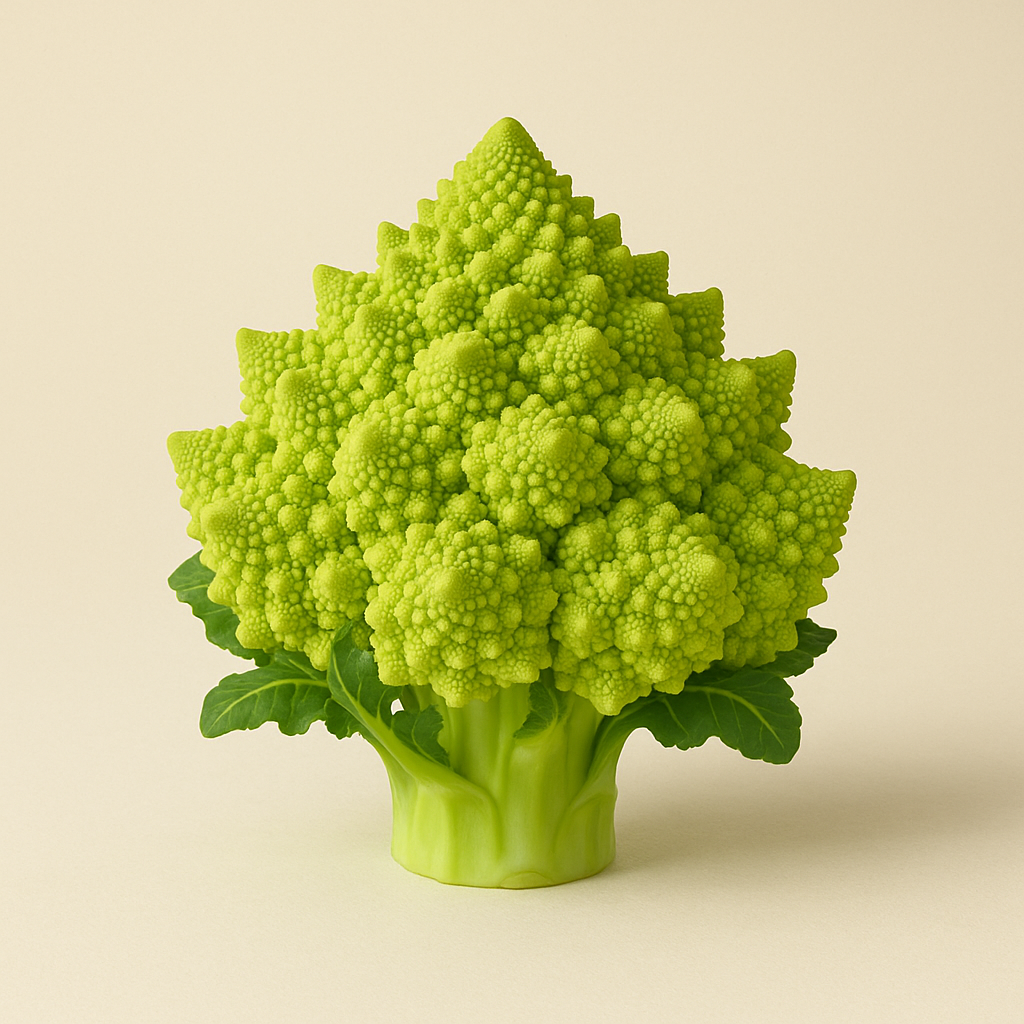
Romanesco Broccoli
Brassica oleracea var. botrytis
Family: Brassicaceae
Romanesco is a stunning vegetable with lime-green spiraling fractals that look like something from another planet. A form of broccoflower, it has a milder, nuttier flavor than broccoli or cauliflower.
Days to Harvest
75-100 days
Sun Needs
Full Sun (6+ hours)
high
Germination Temp
70°F optimal
Start Indoors
6 weeks before last frost
Germination
4-10 days
Seed Depth
1/4 to 1/2 inch
Light to Germinate
No
💡 Tip: Start indoors and transplant carefully. Sensitive to temperature fluctuations.
Soil Type
Rich, well-draining soil with organic matter
pH Range
6 - 7
Spacing
24 inches between plants
⚠️ Avoid planting near:
History
Romanesco broccoli emerged in the Lazio region of Italy, likely around the 15th or 16th century, where it was developed near Rome—giving rise to its name "Broccolo Romanesco." First documented descriptions appear in Italian agricultural texts from the 1500s, though the vegetable may have existed earlier in monastery gardens. What makes romanesco truly remarkable is its naturally occurring fractal geometry: each bud is composed of a series of smaller buds arranged in a logarithmic spiral that follows the Fibonacci sequence, a mathematical pattern found throughout nature. This striking appearance captured the attention of mathematicians and artists as much as cooks, with Leonardo da Vinci reportedly sketching similar natural spirals. For centuries romanesco remained largely unknown outside Italy, a regional specialty of Roman markets and trattorias. Only in the late 20th century did it begin appearing in specialty markets across Europe and North America, embraced by chefs who appreciated both its visual drama and its delicate, nutty flavor that bridges the gap between cauliflower and broccoli. Today romanesco has become a symbol of the intersection between nature, mathematics, and culinary art.
Nutritional Benefits
- ✓High in Vitamin C
- ✓Good source of fiber
- ✓Contains Vitamin K
Optimal Growing Temp
60°F - 70°F
Romanesco requires precise cool temperatures between 60-70°F for proper head formation. It is more temperature-sensitive than broccoli or cauliflower—even brief heat spells can ruin head development. The fractal spirals only form correctly in consistently cool conditions.
Survival Range
35°F - 80°F
Can survive these temperatures
Frost Note: Romanesco tolerates light frosts down to 25°F once established. Some growers report that light frost exposure improves sweetness, similar to Brussels sprouts. Protect forming heads from hard freezes.
Best USDA Zones
Humidity
50-70%
Moderate humidity is best. The tight spiral structure can trap moisture, so good air circulation is important in humid climates to prevent rot.
Height
18-24 inches
Spread
18-24 inches
Growth Habit
upright
Germination
5-10 days
Seeds germinate at 50-80°F, with optimal germination around 70°F. Germination is similar to cauliflower.
Seedling Stage
Duration: 4-6 weeks
True leaves: First true leaves appear 7-10 days after sprouting with typical brassica shape
Transplant ready: Ready to transplant when 4-5 inches tall with 4-6 true leaves. Harden off carefully—Romanesco is sensitive to transplant shock.
Vegetative Growth
Duration: 6-8 weeks after transplant
Extended vegetative phase building large leaves to support the intricate head. Romanesco needs longer than broccoli or cauliflower to mature.
Flowering
Timing: 75-100 days after transplant
Duration: Head forms over 2-3 weeks as spiral pattern develops
The edible head is composed of immature flower buds arranged in mathematical spiral patterns. If left unharvested, it opens into yellow flowers.
Harvest Maturity
Timing: 75-100 days from transplant
- Head reaches 6-8 inches in diameter
- Spiral fractals are tight and well-defined
- Chartreuse-green color is bright and even
- Spirals have not begun to separate or loosen
- No yellowing or browning of florets
Per Plant
1-2 lbs per head
Per Square Foot
0.5-1 lb per square foot
Harvest Frequency
One head per plant (Romanesco rarely produces side shoots)
Factors Affecting Yield
- •Temperature consistency is critical—heat ruins the spiral pattern
- •Fall planting gives best results with cooling temperatures during head formation
- •Consistent moisture prevents malformed heads
- •Adequate nutrition without excess nitrogen
- •The 75-100 day maturity requires careful planning for cool weather harvest
Seedling Stage
Keep consistently moist—water daily if needed
Established Plants
1-1.5 inches per week, maintaining consistent soil moisture
During Fruiting
Even moisture is critical during head formation—stress ruins the spirals
Preferred Method
Drip irrigation or soaker hoses at soil level. Avoid wetting the developing head to prevent rot.
⚠️ Critical Watering Periods
- • Head formation
- • Hot weather
Pro Tips
- Romanesco is less forgiving of water stress than broccoli
- Mulch heavily to maintain even soil moisture
- Inconsistent watering causes malformed heads
- The intricate structure requires consistent conditions throughout growth
Feeding Schedule
At Transplanting
Balanced fertilizer with compost
Once at planting
Vegetative Growth
Balanced fertilizer
Every 2-3 weeks
Head Formation
Lower nitrogen, higher phosphorus/potassium
Every 3 weeks
Organic Options
Side-dress with compost every 3-4 weeks. Kelp meal provides trace minerals. Reduce nitrogen when heads begin forming.
Minimum Size
7 gallon minimum
Recommended Size
10-15 gallon for best results
Depth Required
At least 12 inches deep
Container Tips
- Container growing works but challenging due to Romanesco's long season and temperature sensitivity
- Position where plants get morning sun but protection from afternoon heat
- Use premium potting mix enriched with compost
- Water consistently—container soil dries out faster
- Feed every 2-3 weeks with balanced fertilizer
- May need to move containers to cooler locations in warm weather
Why Prune
When
As needed throughout the season
How Often
Rarely needed
Technique
Remove only yellowed or damaged leaves. Leave all healthy foliage to support head development.
Remove
- ✗ Yellowed or diseased leaves
Keep
- ✓ All healthy leaves—the large leaf canopy is essential for head formation