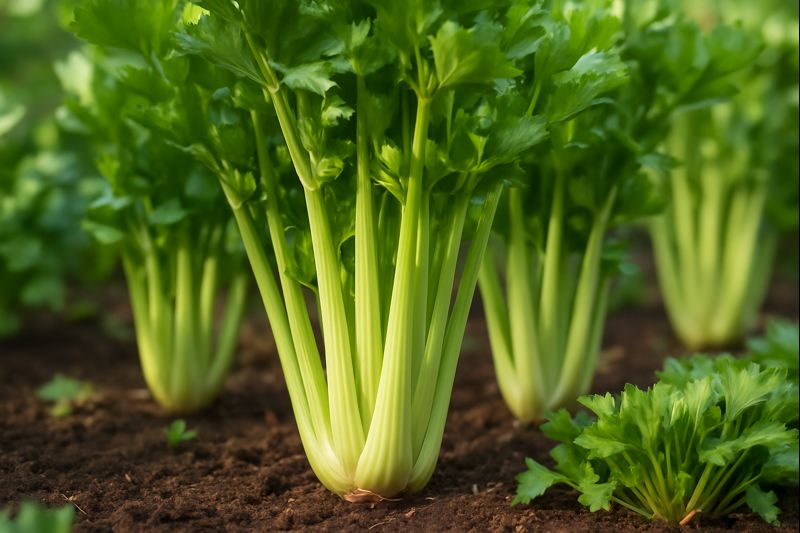
Celery
Apium graveolens
Family: Apiaceae
Celery is a biennial vegetable grown as an annual for its crisp, succulent stalks and aromatic leaves. Known for its distinctive savory flavor and satisfying crunch, celery is both a culinary staple and a challenging but rewarding crop for home gardeners. The plant produces ribbed stalks arranged in a tight bunch with feathery leaves at the top, requiring consistent moisture and cool temperatures for optimal development.
Days to Harvest
100-120 days
Sun Needs
Full Sun (6-8 hours)
high
Germination Temp
70°F optimal
Start Indoors
12 weeks before last frost
Germination
14-21 days
Seed Depth
Surface sow (needs light)
Light to Germinate
Yes
💡 Tip: Seeds are tiny and slow to germinate. Soak in warm water 12-24 hours before sowing. Press gently into soil surface but don't cover. Keep moist with spray bottle. Bottom heat (70°F) improves germination. Pot up when 2-3 true leaves appear.
Soil Type
Rich, moisture-retentive, high organic matter
pH Range
6 - 7
Spacing
8 inches between plants, 24 inches between rows
⚠️ Avoid planting near:
History
Celery has a long and fascinating history that begins not as a food, but as medicine. Wild celery (Apium graveolens) grows in marshy areas throughout Europe, the Mediterranean, and parts of Asia, where ancient peoples used it primarily for medicinal purposes—the ancient Greeks awarded celery leaves to victorious athletes and used them to make garlands for the dead, while Hippocrates prescribed celery as a nerve tonic. The Romans used it as a seasoning, but primarily the leaves and seeds; the fibrous stalks were considered too bitter and tough to eat. The transformation of celery from medicinal herb to vegetable crop began in Italy during the Renaissance (16th-17th centuries), where Italian gardeners in the Po River valley bred wild celery for less bitterness, thicker stalks, and better texture. They developed the technique of "blanching"—mounding soil or wrapping the stalks to exclude light—which produces milder, more tender celery by preventing chlorophyll formation. This blanched celery became fashionable in France and England by the 1700s and was considered a luxury vegetable, often presented in ornate celery vases at Victorian dinner tables. Celery arrived in North America with European colonists and by the 1850s had become a commercial crop, particularly in Kalamazoo, Michigan, which became known as "Celery City" and dominated U.S. celery production in the late 1800s. The development of self-blanching varieties in the 20th century, along with mechanical harvesting and refrigerated transportation, transformed celery from an expensive delicacy to an everyday staple. Today, celery is the second most popular vegetable in the United States after lettuce, with California's Salinas Valley producing most of the commercial crop.
Nutritional Benefits
- ✓Extremely low in calories (only 6 calories per stalk)
- ✓High in fiber for digestive health
- ✓Good source of Vitamin K for blood clotting
Optimal Growing Temp
60°F - 70°F
Celery is demanding about temperature, preferring consistently cool conditions (60-70°F). Temperatures below 55°F for extended periods can trigger bolting. Heat above 80°F causes tough, stringy stalks with hollow centers.
Survival Range
40°F - 85°F
Can survive these temperatures
Frost Note: Young plants can tolerate light frost (down to 25°F) but extended cold below 55°F triggers vernalization and bolting. Mature plants handle fall frosts better than spring transplants. Protect from hard freezes.
Best USDA Zones
Humidity
60-80%
High humidity preferred—celery evolved in boggy, coastal environments. Low humidity causes tough, stringy stalks and increases water needs. Good air circulation prevents fungal diseases.
Height
18-24 inches
Spread
8-12 inches
Growth Habit
upright
Germination
14-21 days
Celery seeds are tiny and notoriously slow to germinate. Require light for germination—press into soil surface without covering. Seeds germinate best at 70-75°F with consistent moisture.
Seedling Stage
Duration: 6-8 weeks
True leaves: True leaves are deeply divided and fernlike, resembling parsley (same family). Seedlings grow very slowly at first—patience is essential.
Transplant ready: Ready to transplant when 4-6 inches tall with well-developed root system. Harden off gradually to prevent cold shock that triggers bolting.
Vegetative Growth
Duration: 10-14 weeks
Long growing period where stalks gradually thicken and lengthen. Requires consistent moisture, nutrients, and cool temperatures throughout. The classic ribbed, tight bunch form develops slowly.
Harvest Maturity
Timing: 100-120 days from transplant, 140-160 days from seed
- Stalks are thick (1-2 inches) and tightly bunched
- Height is 18-24 inches from soil to first leaves
- Stalks are crisp and snap cleanly when bent
- No visible flower stalk in center
Per Plant
1-2 lbs per plant (one full bunch)
Per Square Foot
1-2 lbs per square foot (one plant per sq ft)
Harvest Frequency
Harvest outer stalks as needed or entire plant at maturity
Factors Affecting Yield
- •Consistent moisture is the most critical factor for quality
- •Blanching produces milder, more tender stalks
- •Fall crops often produce better quality than spring crops
- •Hot weather significantly reduces yield and quality
Seedling Stage
Mist daily to maintain constant moisture—never let seeds or seedlings dry out
Established Plants
Water deeply every 1-2 days, keeping soil consistently moist at all times
During Fruiting
Continue daily or every-other-day deep watering—celery is extremely water-dependent
Preferred Method
Drip irrigation or soaker hoses ideal for consistent moisture without wetting foliage. Heavy mulching (3-4 inches) essential to retain moisture. Water at soil level to prevent disease.
⚠️ Critical Watering Periods
- • Entire growing season—celery has no drought-tolerant period
- • Final 4-6 weeks before harvest when stalks are sizing up
Pro Tips
- Celery is one of the most water-demanding vegetable crops
- Even brief dry periods cause irreversible damage to stalk quality
- Heavy mulching is essential for maintaining moisture
- Water in morning to prevent fungal diseases on foliage
- Self-watering containers or sub-irrigation systems work well
Feeding Schedule
At planting
Compost and balanced fertilizer
Once at planting (3-4 inches compost)
Every 3-4 weeks
Compost or balanced fertilizer
Every 3-4 weeks; foliar feed with fish emulsion
Midseason
Extra nitrogen application
Once if growth slows
Organic Options
Apply 3-4 inches of compost at planting, side-dress monthly with additional compost, foliar feed every 2 weeks with fish emulsion
Minimum Size
8 inches wide, 10 inches deep per plant
Recommended Size
12 inches wide, 12 inches deep for each plant
Depth Required
10-12 inches minimum for shallow but spreading root system
Best Varieties for Containers
Container Tips
- Container growing allows for better moisture control
- Use self-watering containers for best results—celery needs constant moisture
- Place containers in cool, partially shaded locations in warm weather
- Group containers together to maintain humidity around plants
- Container celery is more challenging than most vegetables—not recommended for beginners
Why Prune
When
Begin harvesting outer stalks when they reach 8 inches tall. Harvest entire plant before hard frost.
How Often
Harvest outer stalks every 1-2 weeks as needed, or harvest entire plant at maturity
Technique
Cut outer stalks at base with clean knife, leaving inner stalks to continue growing. For whole plant, cut at soil level. Optional: blanch for 2-3 weeks before harvest.
Remove
- ✗ Outer mature stalks for eating
- ✗ Yellowing or damaged stalks
- ✗ Any flower stalks that appear
Keep
- ✓ Inner developing stalks
- ✓ Growing heart for continued production
- ✓ Healthy green leaves (edible and flavorful)