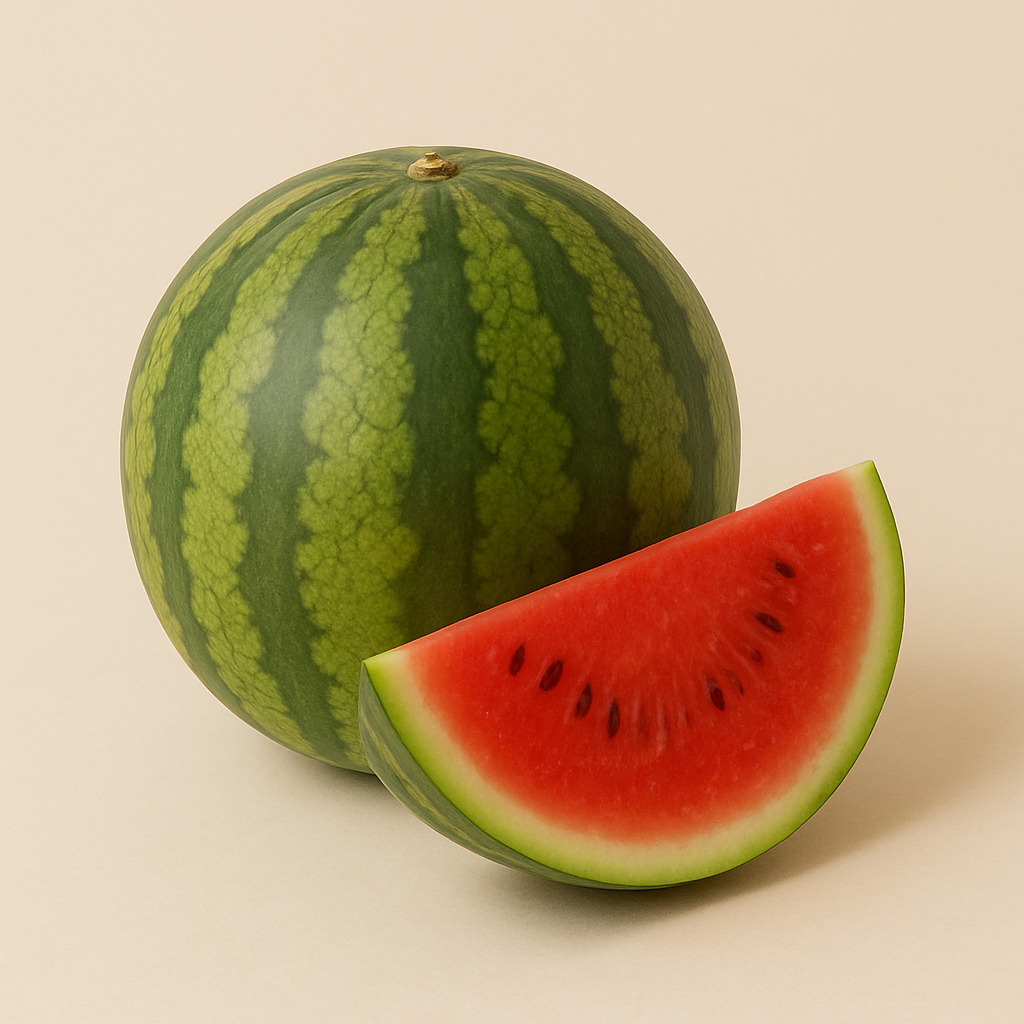
Watermelon
Citrullus lanatus
Family: Cucurbitaceae
Watermelons are the quintessential summer fruit, with sweet, juicy flesh that's over 90% water—perfect for hot days. From giant picnic melons to personal-sized "icebox" types, there's a watermelon for every garden size. They need heat, space, and patience.
Days to Harvest
70-100 days
Sun Needs
Full Sun (8+ hours)
high
Germination Temp
85°F optimal
Start Indoors
3 weeks before last frost
Germination
4-12 days
Seed Depth
1 inch
Light to Germinate
No
💡 Tip: Requires warm soil (70°F+). Use black plastic mulch to warm soil in cooler climates. Start indoors in short-season areas but transplant carefully.
Soil Type
Sandy loam, well-draining, rich in organic matter
pH Range
6 - 6.8
Spacing
6-8 feet between plants in rows 8-10 feet apart
⚠️ Avoid planting near:
History
Watermelons trace their origins to the sun-scorched Kalahari Desert of southern Africa, where wild ancestors still grow today, their bitter white flesh prized not for sweetness but for life-giving moisture in an arid land. Archaeological evidence from Libya dates cultivation to at least 5,000 years ago, and watermelon seeds discovered in Pharaoh Tutankhamun's tomb suggest their importance as provisions for the afterlife journey. Ancient Egyptians depicted watermelons in hieroglyphics and tomb paintings, recognizing them as essential desert survival food. The fruit traveled the Silk Road to China by the 10th century, where it became so beloved that the Chinese now produce more watermelon than any other nation. Moorish traders introduced watermelons to Spain, from which Spanish colonizers brought them to the Americas in the 16th century. African slaves brought watermelon seeds and cultivation knowledge to the American South, where the fruit became deeply embedded in summer culture—and tragically weaponized as a racist stereotype, a history that continues to complicate the fruit's cultural legacy. Today, over 1,200 varieties exist worldwide, from traditional oblong striped melons to black-skinned Densuke watermelons that sell for thousands of dollars in Japan.
Nutritional Benefits
- ✓Very high water content (92%)
- ✓Contains lycopene (antioxidant)
- ✓Good source of Vitamin C
Optimal Growing Temp
75°F - 90°F
Watermelons are heat-loving plants that thrive in temperatures between 75-90°F. Growth slows significantly below 70°F and above 95°F. Nights above 65°F are ideal for fruit development.
Survival Range
60°F - 100°F
Can survive these temperatures
Frost Note: Watermelons are killed by any frost. Even temperatures below 50°F cause significant damage and stunted growth. Do not plant until soil has warmed to at least 70°F.
Best USDA Zones
Humidity
50-70%
Moderate humidity is best. High humidity can promote foliar diseases like powdery mildew. In humid climates, ensure excellent air circulation and avoid overhead watering.
Height
12-18 inches (vines spread horizontally)
Spread
8-15 feet
Growth Habit
vine
Germination
4-12 days
Seeds germinate best at 85-95°F soil temperature. Use black plastic mulch or heat mats. First sprouts emerge with large seed leaves (cotyledons).
Seedling Stage
Duration: 2-3 weeks
True leaves: First true leaves appear 7-10 days after sprouting
Transplant ready: Ready when 3-4 inches tall with 2-3 true leaves. Transplant very carefully as watermelons resent root disturbance. Use biodegradable pots.
Vegetative Growth
Duration: 3-5 weeks after transplant
Rapid vine growth with large, deeply lobed leaves. Vines can grow 12-18 inches per week in warm conditions. This phase builds the extensive foliage needed to support heavy fruits.
Flowering
Timing: 4-6 weeks after transplant or direct sowing
Duration: 3-4 weeks of intensive flowering
Watermelons produce separate male and female flowers on the same plant. Males appear first, females have a small swollen base (baby melon). Bees are essential for pollination. Hand-pollinate in early morning if pollinators are scarce.
Fruit Development
Begins: Begins 1-2 weeks after successful pollination
Duration: 30-50 days from pollination to ripe fruit
Fruits grow rapidly, gaining 1-2 pounds per day at peak growth. The ground spot (where melon rests) changes from white to creamy yellow when ripe.
Harvest Maturity
Timing: 70-100 days from transplant or direct sowing
- Ground spot turns from white to creamy yellow
- Tendril nearest the fruit stem turns brown and dry
- Hollow sound when thumped (ripe), dull thud when underripe
- Rind resists fingernail scratch
- Surface becomes dull rather than shiny
Per Plant
2-4 melons per plant (20-80 lbs total depending on variety)
Per Square Foot
10-15 lbs per square foot when trellised vertically
Harvest Frequency
Harvest when ripe indicators appear (melons do not ripen after picking)
Factors Affecting Yield
- •Variety - icebox types produce more fruits per plant but smaller size
- •Pollination success - lack of pollinators dramatically reduces yield
- •Consistent watering during fruit development - prevents blossom end rot
- •Adequate spacing - crowded plants produce fewer, smaller melons
- •Heat accumulation - melons need sustained hot weather to size up and sweeten
- •Pruning - limiting to 2-3 fruits per vine produces larger melons
Seedling Stage
Keep soil consistently moist but not waterlogged. Water daily in warm weather.
Established Plants
1-2 inches per week through deep, infrequent watering. Increase to 2 inches during fruiting.
During Fruiting
Critical period - consistent moisture prevents cracking and blossom end rot. Reduce watering when fruit begins to ripen to concentrate sugars.
Preferred Method
Drip irrigation or soaker hoses are ideal. Avoid overhead watering which promotes fungal diseases. Water in morning so foliage dries before evening.
⚠️ Critical Watering Periods
- • Flowering and fruit set
- • Fruit sizing (first 3 weeks after pollination)
Pro Tips
- Watermelons need deep watering to encourage deep roots - shallow watering creates weak plants
- Mulch heavily to retain moisture and keep soil temperature consistent
- Water at soil level, never overhead, to prevent foliar diseases
- Reduce watering as melons ripen (when ground spot turns yellow) to concentrate sugars
- In extreme heat, vines may wilt midday even with adequate moisture - this is normal
Feeding Schedule
At planting
Balanced 10-10-10 or rich compost worked into soil
Once at transplanting
Vegetative growth
Side-dress with compost or balanced fertilizer
Every 2-3 weeks
Flowering begins
Switch to low-nitrogen 5-10-10 or bloom booster
Every 2 weeks
Fruit development
Potassium-rich fertilizer (promotes sweetness)
Every 2-3 weeks until 2 weeks before harvest
Organic Options
Side-dress with compost monthly. Foliar feed with fish emulsion every 2 weeks during early growth. Apply potassium sources when fruits begin to size up.
Minimum Size
20 gallon minimum for small icebox varieties
Recommended Size
30-40 gallon for standard varieties (not practical for giant types)
Depth Required
At least 18-24 inches deep
Best Varieties for Containers
Container Tips
- Only grow small icebox varieties like Sugar Baby in containers
- Provide very sturdy vertical trellis to support heavy fruit
- Use slings made from old t-shirts or pantyhose to support melons on vertical trellis
- Water daily in hot weather - large leaves transpire enormous amounts
- Feed every 2 weeks with balanced fertilizer, reduce nitrogen when flowering starts
- Position container in hottest, sunniest spot available
Support Type
Heavy-duty A-frame or cattle panel trellis for vertical growing (optional but space-saving)
Height Needed
5-6 feet tall
When to Install
Install trellis before planting or transplanting
Method
Train main vines up trellis, securing loosely with soft ties. As fruits develop beyond softball size, support each melon in a sling made from stretchy fabric (old t-shirts work perfectly). The sling distributes weight and prevents premature dropping.
Tips
- Vertical growing saves enormous space but requires strong support
- Use cattle panels or very sturdy trellis rated for heavy loads
- Create slings when fruits are cantaloupe-sized - don't wait until heavy
- Check slings daily as fruits gain 1-2 lbs per day
- Limit to 2-3 fruits per vine when trellising
- Icebox varieties (8-12 lbs) are much easier to trellis than standard types
Why Prune
When
When fruits reach softball size, select 2-3 best fruits per plant and remove others
How Often
Once when fruits are sizing, plus ongoing removal of damaged foliage
Technique
Use clean shears to remove excess baby melons and any damaged or misshapen fruits. Optionally prune side shoots and excess vines to keep plant manageable. Remove any yellowing or diseased leaves.
Remove
- ✗ Excess baby melons beyond the 2-3 best specimens
- ✗ Late-forming flowers that won't have time to mature
- ✗ Diseased or yellowing leaves
- ✗ Overly long runners in confined spaces
Keep
- ✓ Healthy green foliage (needed to fuel fruit development)
- ✓ The 2-3 most promising fruits per vine
- ✓ Main vines with good leaf coverage