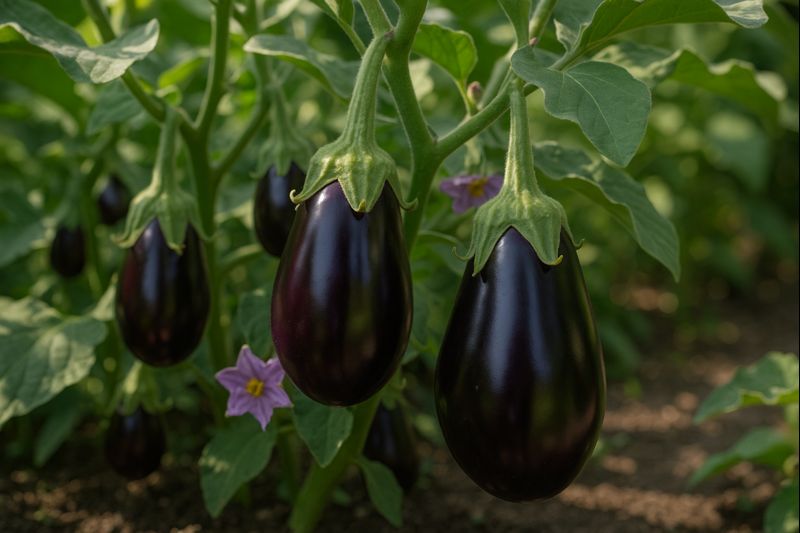
Eggplant
Solanum melongena
Family: Solanaceae
Eggplant (aubergine in British English) is a warm-season vegetable with glossy, deep purple skin and creamy white flesh that becomes tender and silky when cooked. Despite its name, most varieties bear no resemblance to eggs—the name comes from 18th-century European cultivars that produced small, white, egg-shaped fruits. Modern eggplants range from the classic large globe types to slender Japanese varieties, each offering unique textures and flavors perfect for grilling, roasting, frying, and baking.
Days to Harvest
50-85 days
Sun Needs
Full Sun (6-8+ hours)
moderate
Germination Temp
85°F optimal
Start Indoors
10 weeks before last frost
Germination
7-14 days
Seed Depth
1/4 inch
Light to Germinate
No
💡 Tip: Eggplant seeds require consistently warm soil temperatures for germination. Use a heat mat to maintain 80-85°F. Germination can be slow and erratic without adequate heat. Transplant only after all danger of frost has passed and soil has warmed to at least 60°F.
Soil Type
Rich, well-draining soil with high organic matter. Eggplants are heavy feeders.
pH Range
5.5 - 6.5
Spacing
24-30 inches between plants, 30-36 inches between rows
⚠️ Avoid planting near:
History
Eggplant is one of the world's most ancient cultivated vegetables, with archaeological and linguistic evidence suggesting domestication in the Indian subcontinent and Southeast Asia over 4,000 years ago. Wild ancestors (Solanum incanum) still grow in India and Burma, where early farmers selected for larger fruits and reduced bitterness. Ancient Sanskrit texts from 300 BCE mention eggplant cultivation, and Chinese agricultural records document its spread to China by 500 CE, where it became known as "qiezi." Arab traders brought eggplant westward through Persia and the Middle East during the 7th and 8th centuries, integrating it into Islamic cuisine—the famous baba ganoush emerged during this period. When eggplant reached the Mediterranean around the 13th century, Europeans initially feared it as poisonous or capable of inducing insanity, calling it "mala insana" (mad apple) due to its nightshade family connection. This suspicion persisted for centuries; Thomas Jefferson, an adventurous gardener, was among the first Americans to cultivate eggplant in the 1780s, though it remained a curiosity rather than a staple. Italian and Greek immigrants in the late 19th and early 20th centuries finally popularized eggplant in America, bringing dishes like eggplant parmesan and moussaka that transformed the "mad apple" into a beloved ingredient. The large, purple Globe eggplant became the American standard, while Asian communities maintained traditions of growing slender Japanese and Chinese varieties. Today, eggplant cultivation exceeds 54 million tons annually worldwide, with China and India producing over 85% of the global supply.
Nutritional Benefits
- ✓Low in calories but filling—only 25 calories per cup
- ✓Good source of dietary fiber for digestive health
- ✓Contains nasunin, a powerful antioxidant found in the purple skin