Asparagus
Asparagus officinalis
Family: Asparagaceae
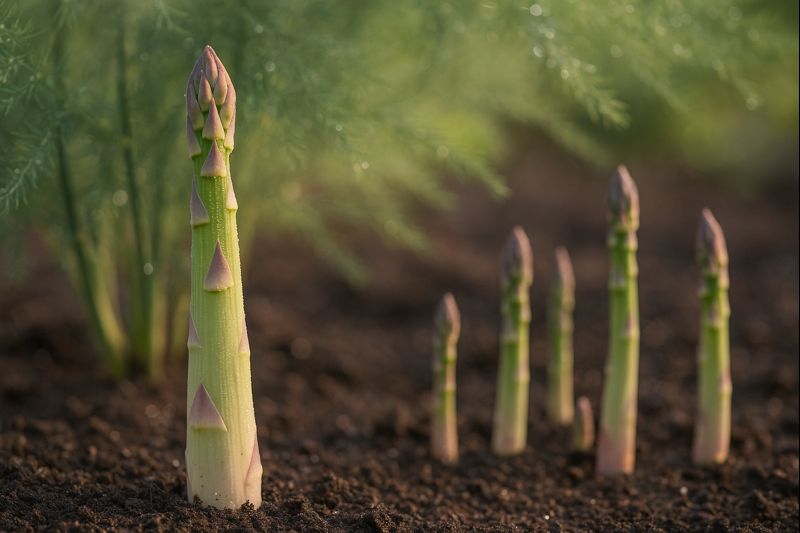
Asparagus is a long-lived perennial vegetable producing tender, delicious spears each spring for 15-20+ years once established. While it requires patience—taking 2-3 years before first harvest—asparagus rewards gardeners with one of the finest spring delicacies, emerging when little else is ready to harvest. The fern-like foliage that follows adds ornamental beauty to the garden all summer.
Days to Harvest
730-1095 days
Sun Needs
Full Sun (6-8 hours minimum)
moderate
Germination Temp
75°F optimal
Start Indoors
0 weeks before last frost
Germination
14-21 days
Seed Depth
1/2 to 1 inch
Light to Germinate
No
💡 Tip: Asparagus is almost always grown from 1-year-old dormant crowns rather than seed—this saves a full year of establishment time. If starting from seed, soak seeds for 2 days before planting and transplant seedlings after one growing season. Plant crowns in early spring (March-April) in trenches 6-8 inches deep, spreading roots like an octopus. Cover with 2-3 inches of soil initially, gradually filling trench as shoots emerge.
Soil Type
Deep, well-draining, sandy loam rich in organic matter
pH Range
6.5 - 7.5
Spacing
12-18 inches between plants, 4-5 feet between rows—asparagus needs room for extensive root systems
⚠️ Avoid planting near:
History
Asparagus has been prized as a luxury vegetable for over 2,000 years, cultivated by ancient Egyptians, Greeks, and Romans who considered it worthy of gods and emperors. The ancient Egyptians offered asparagus to their gods as early as 3000 BCE, with depictions appearing in hieroglyphics and tomb paintings. Greek physicians Hippocrates and Galen prescribed asparagus for its supposed medicinal properties, particularly as a diuretic. The Romans elevated asparagus cultivation to an art form—Pliny the Elder described meticulous growing techniques and noted that Emperor Augustus coined the phrase "velocius quam asparagi conquantur" (faster than cooking asparagus) to describe anything done swiftly. Roman gourmands prized the thick "Ravenna" variety so much that they maintained special "asparagus fleets" of fast ships to rush fresh spears from growing regions to Rome. After the fall of Rome, asparagus cultivation nearly disappeared in Europe, surviving mainly in monastery gardens where monks preserved Roman horticultural knowledge. The vegetable resurged during the Renaissance; French King Louis XIV, obsessed with fresh asparagus year-round, ordered his gardener La Quintinie to develop forcing techniques in heated greenhouses, making asparagus a symbol of royal excess. The Dutch perfected white asparagus cultivation in the 18th century by burying spears under soil mounds to prevent photosynthesis—this labor-intensive "white gold" became a delicacy commanding premium prices. German immigrants brought asparagus to America, establishing major growing regions in California and Michigan. The Martha Washington variety, developed in 1949 for rust resistance, became the standard American asparagus for decades. Purple asparagus varieties, naturally sweeter due to higher sugar content, have ancient origins but were reintroduced to modern gardens through Italian heirlooms like "Violetto d'Albenga." Today, asparagus remains one of the most expensive vegetables due to its perennial nature, hand-harvesting requirements, and relatively short season—yet home gardeners with established beds enjoy this luxury for pennies per pound, harvesting spears so fresh and sweet they're a completely different vegetable than store-bought specimens.
Nutritional Benefits
- ✓Very high in folate (essential for cell growth and DNA formation)
- ✓Excellent source of Vitamins K, A, C, and E
- ✓Rich in fiber and aids digestive health
Optimal Growing Temp
60°F - 80°F
Asparagus needs cold winters for dormancy. Grows in spring when soil warms to 50°F.
Survival Range
-20°F - 95°F
Can survive these temperatures
Frost Note: Extremely cold hardy—crowns survive to -40°F. Established plants emerge after last frost.
Best USDA Zones
Humidity
50-70%
Adaptable to various humidity levels.
Height
4-6 feet (ferns)
Spread
3-4 feet
Growth Habit
upright
Germination
14-21 days (from seed)
Seeds slow. Most plant 1-year crowns for faster establishment.
Seedling Stage
Duration: 1-2 years (establishment)
True leaves: Ferny foliage develops
Transplant ready: Plant crowns in trenches 6-12 inches deep.
Vegetative Growth
Duration: Years 1-2
Do not harvest—let ferns build crown strength.
Harvest Maturity
Timing: Year 3+ for full harvest
- Thick spears 3/8-3/4 inch diameter
- Spears 6-8 inches tall
- Tight tips
Per Plant
1/2 lb per established crown per season
Per Square Foot
1 crown per 1.5 sq ft
Harvest Frequency
Every 2-3 days for 6-8 weeks in spring
Factors Affecting Yield
- •Crown age
- •Soil fertility
- •Winter chill
Seedling Stage
1 inch per week during establishment
Established Plants
1-2 inches per week during growing season
During Fruiting
Consistent moisture during harvest
Preferred Method
Drip irrigation or soaker hoses.
⚠️ Critical Watering Periods
- • Harvest season
- • Fern growth
Pro Tips
- Water deeply. Mulch heavily to conserve moisture.
Feeding Schedule
Early spring
Balanced fertilizer or compost
Once before spears emerge
After harvest
Side-dress with compost
Once to support fern growth
Organic Options
Apply 2-3 inches compost annually.
Minimum Size
Not recommended—perennial needs permanent space
Recommended Size
In-ground beds
Depth Required
18+ inches
Container Tips
- Asparagus needs permanent bed. Not suited to containers.