Horseradish
Armoracia rusticana
Family: Brassicaceae
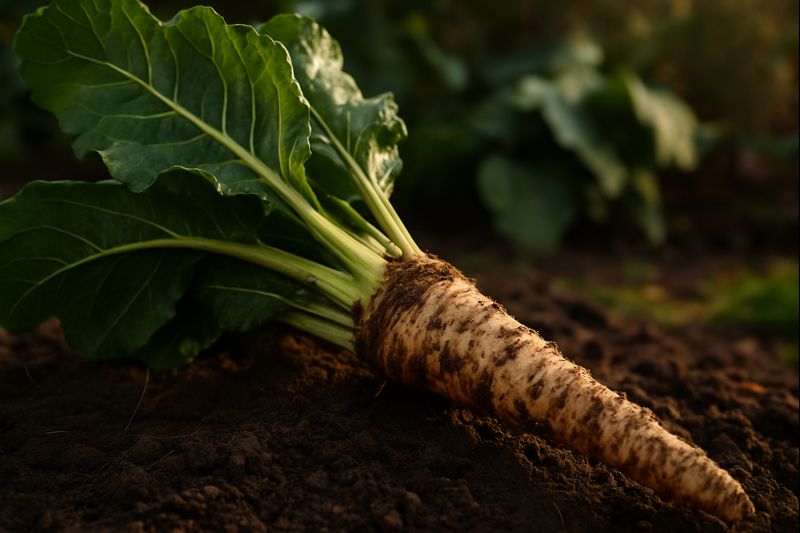
Horseradish is a hardy perennial grown for its pungent, spicy taproot used as a condiment. This vigorous plant produces large, wavy leaves and thick white roots that contain sinigrin, a compound that releases the distinctive sharp, nasal-clearing heat when grated. Unlike hot peppers that burn the tongue, horseradish's heat dissipates quickly and affects the sinuses. Once established, horseradish is nearly indestructible and can become invasive if not contained.
Days to Harvest
150-365 days
Sun Needs
Full Sun to Partial Shade (4+ hours)
moderate
Germination Temp
55°F optimal
Start Indoors
0 weeks before last frost
Germination
0-0 days
Seed Depth
Not grown from seed
Light to Germinate
No
💡 Tip: Horseradish is grown from root cuttings (sets), not seeds. Plant root cuttings 4-6 inches long in early spring or late fall. Set roots at 45-degree angle with top 2 inches below soil surface, pointed end down. Space 18-24 inches apart in deep, loose soil.
Soil Type
Deep, rich, moist soil. Tolerates wide range but prefers loose loam.
pH Range
6 - 7.5
Spacing
18-24 inches between plants, 30-36 inches between rows
⚠️ Avoid planting near:
History
Horseradish has been cultivated for over 3,000 years, with its origins traced to Eastern Europe and Western Asia, particularly the regions around the Caspian Sea. The ancient Egyptians knew of horseradish as early as 1500 BCE, and the Greek oracle at Delphi told Apollo that horseradish was worth its weight in gold. Ancient Greeks used it as both a medicinal herb and an aphrodisiac, while the Romans brought it to Western Europe, where it quickly spread through Central Europe. The plant's common name combines "horse" (meaning strong or coarse) with "radish" (for its appearance when young). In medieval times, horseradish was primarily used medicinally to treat everything from coughs to scurvy, and only later became popular as a condiment. German immigrants brought horseradish to North America in the 1600s, where it thrived in colonial gardens. The commercial horseradish industry began in the mid-1800s when German immigrants in the Midwest, particularly around Collinsville, Illinois (which became the "Horseradish Capital of the World"), began cultivating and processing it commercially. Jewish immigrants particularly embraced horseradish as a key ingredient in preparing maror (bitter herbs) for Passover Seders, establishing it as essential in Jewish cuisine. During the Victorian era, horseradish sauce became the classic accompaniment to roast beef in British cuisine, a tradition that continues today. In the early 1900s, horseradish was one of the five bitter herbs used in the first recorded Bloody Mary cocktail. Today, approximately 6 million gallons of prepared horseradish are produced annually in the United States alone, with 60% of the world's horseradish still grown within a few miles of Collinsville, Illinois. The perennial nature and extreme hardiness of horseradish mean that roots dug from century-old homesteads still thrive when replanted, creating a living link to generations of gardeners past.
Nutritional Benefits
- ✓Very high in Vitamin C
- ✓Contains glucosinolates with antibacterial properties
- ✓Good source of calcium and potassium