Potatoes
Solanum tuberosum
Family: Solanaceae
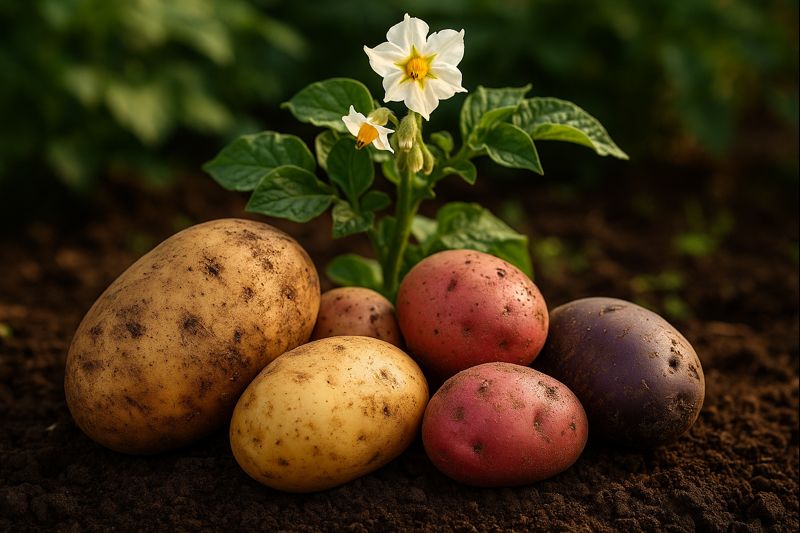
Potatoes are the world's most important tuber crop and the fourth most important food crop overall after rice, wheat, and corn. These versatile vegetables grow as swollen underground stems (tubers) that store energy for the plant. Available in countless varieties with different colors, shapes, textures, and flavors, potatoes can be grown in garden beds, raised beds, containers, or even bags. They thrive in cool weather and relatively poor soil, making them accessible to gardeners worldwide.
Days to Harvest
75-120 days
Sun Needs
Full Sun (6+ hours)
moderate
Germination Temp
60°F optimal
Start Indoors
0 weeks before last frost
Germination
14-28 days
Seed Depth
3-4 inches
Light to Germinate
No
💡 Tip: Potatoes are grown from "seed potatoes"—small whole potatoes or cut pieces with at least 2-3 eyes each. Let cut pieces dry (cure) for 24-48 hours before planting to prevent rot. Plant with eyes facing up. Certified disease-free seed potatoes are essential.
Soil Type
Loose, well-drained, acidic soil. Prefers sandy loam rich in organic matter.
pH Range
5 - 6.5
Spacing
12 inches between plants, 30-36 inches between rows
⚠️ Avoid planting near:
History
The potato's journey from sacred Incan crop to global staple is one of history's most remarkable agricultural stories, marked by triumph, tragedy, and transformation. Wild potatoes have grown in the Andes mountains of South America for millennia, with archaeological evidence placing potato cultivation in Peru and Bolivia as far back as 8000 BCE. The Inca civilization developed hundreds of varieties adapted to different altitudes and climates, preserving potatoes through freeze-drying to create "chuño" that could be stored for years. Potatoes were so important to Incan culture that they measured time by how long it took to cook potatoes and buried potatoes with their dead as sustenance for the afterlife. Spanish conquistadors encountered potatoes in the 1530s when they invaded Peru, and brought them to Europe around 1570. Initially, Europeans were deeply suspicious—the potato was botanically related to poisonous nightshade, not mentioned in the Bible, and produced its food underground in a manner Europeans found unwholesome. For nearly two centuries, potatoes were considered peasant food at best and pig fodder at worst. Promotion by forward-thinking figures helped change perceptions: Antoine-Augustin Parmentier, a French pharmacist captured during the Seven Years' War, survived on potatoes as a prisoner and spent the rest of his life promoting them (leading to dishes like "Pommes Parmentier"). Frederick the Great of Prussia ordered peasants to plant potatoes on pain of having their noses cut off. Marie Antoinette wore potato blossoms in her hair to make them fashionable. By the 18th century, potatoes had become central to European agriculture, particularly in Ireland where the cool, moist climate proved perfect for cultivation. The Irish population exploded from 1.5 million to 8.5 million between 1600 and 1840, sustained largely by potatoes which could feed a family from a small plot of land. Then disaster struck: Phytophthora infestans, the potato blight, arrived in Ireland in 1845. Because Irish potatoes were genetically uniform clones grown from the same few varieties, the disease swept through fields with devastating speed. The Irish Potato Famine (An Gorta Mór) lasted from 1845 to 1852, killing approximately one million people and forcing another million to emigrate, reducing Ireland's population by 25%. The famine was exacerbated by British colonial policies and indifference, becoming not just an agricultural failure but a humanitarian catastrophe with political ramifications that echo today. Irish immigrants fleeing the famine brought their potato-growing skills to America, where potatoes had already been introduced by Presbyterian immigrants in 1719. In the American West, Luther Burbank developed the Russet Burbank potato in 1872, which became the standard for baking and fries. The 20th century brought industrial-scale potato production, frozen processing, and fast-food chains that transformed potatoes into French fries, hash browns, and tater tots. Today, potatoes are grown in over 150 countries with annual production exceeding 370 million tons. China is now the largest producer, growing over 90 million tons annually. The International Potato Center in Peru maintains a collection of 4,500 varieties, preserving the genetic diversity that could prevent another famine. Modern potatoes come in astonishing variety—purple, blue, red, yellow, and fingerling types that connect today's gardeners with the rich heritage of Andean agriculture that sustained civilizations for 10,000 years.
Nutritional Benefits
- ✓Good source of Vitamin C
- ✓High in potassium (more than bananas)
- ✓Contains Vitamin B6