Rhubarb
Rheum rhabarbarum
Family: Polygonaceae
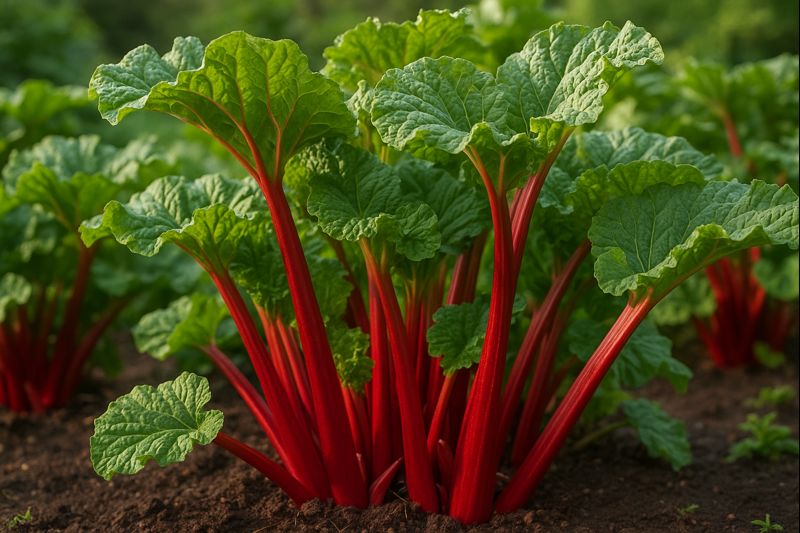
Rhubarb is a cold-hardy perennial vegetable grown for its tart, tangy stalks that are treated as fruit in cooking. Though botanically a vegetable, rhubarb's primary use in pies, jams, and desserts has earned it the nickname "pie plant." Once established, a single rhubarb crown can produce abundant harvests for 15-20+ years. CRITICAL WARNING: Only the stalks are edible—the leaves contain toxic levels of oxalic acid and should NEVER be consumed.
Days to Harvest
730-1095 days
Sun Needs
Full Sun to Partial Shade (4-8 hours, tolerates partial shade in hot climates)
moderate
Germination Temp
65°F optimal
Start Indoors
0 weeks before last frost
Germination
14-21 days
Seed Depth
1/2 inch
Light to Germinate
Yes
💡 Tip: Rhubarb is almost always grown from divided crowns (root divisions) rather than seed—crowns produce harvest-ready plants 1-2 years faster than seed. Plant dormant crowns in early spring with buds 1-2 inches below soil surface. If growing from seed (only recommended for Glaskins Perpetual), start indoors 8-10 weeks before last frost. Most named varieties don't come true from seed—they must be propagated by division.
Soil Type
Rich, deep, well-draining soil with abundant organic matter
pH Range
5.5 - 6.5
Spacing
3-4 feet between plants—rhubarb grows LARGE and needs room for massive leaves
⚠️ Avoid planting near:
History
Rhubarb's transformation from expensive medicinal root to beloved pie filling spans 4,000 years and three continents, with a curious detour through Arctic exploration and wartime Britain. Native to Siberia and Mongolia, rhubarb root was first cultivated around 2700 BCE in China not as food, but as a powerful medicine—Chinese physicians prized it as a purgative and treatment for digestive ailments. For thousands of years, rhubarb root was one of the most valuable medicines traded along the Silk Road, worth more per pound than saffron or opium. Marco Polo encountered rhubarb in 13th-century China and brought news of this wonder-drug back to Europe, where it became a pharmaceutical staple commanding astronomical prices—the Russian monopoly on "Turkey rhubarb" (actually Chinese rhubarb transshipped through Russia) made it worth its weight in precious gems. For centuries, Europeans knew rhubarb only as dried root imported at great expense, unaware the plant could be grown in their own gardens. The game changed in the 1750s when Russian botanist Joseph Hamel sent rhubarb seeds to European gardeners, and experimenters in England discovered that the sour stalks, when sweetened with newly-affordable sugar from Caribbean colonies, made excellent pies and tarts. By the Victorian era, rhubarb had transformed from exotic medicine to common garden vegetable, with British gardeners pioneering "forcing" techniques—covering plants with terracotta cloches to produce tender, sweet stalks in late winter. The "Rhubarb Triangle" in Yorkshire became the epicenter of forced rhubarb production, with dark forcing sheds producing stalks so tender you could hear them growing (the popping sound of cell expansion). During World War I, the British government promoted rhubarb as a substitute for scarce imported fruit, and its high vitamin C content made it valuable for preventing scurvy. The famous "strawberry-rhubarb pie" became an American classic when German and English immigrants brought rhubarb cultivation to North America—the combination of sweet strawberries and tart rhubarb proving irresistible to pioneer palates. Rhubarb's reputation suffered when wartime food shortages in WWII led to dangerous experimentation—desperate families sometimes ate the leaves (toxic due to oxalic acid) after rumors spread that they were edible if cooked, resulting in poisonings. Today, rhubarb endures as a nostalgic favorite in northern climates, with grandmothers' pie recipes passed down as treasured heirlooms—though many younger generations have never tasted this ultra-tart, ultra-perennial "pie plant" that defined spring desserts for their ancestors.
Nutritional Benefits
- ✓Good source of Vitamin K (for blood clotting and bone health)
- ✓Contains Vitamin C
- ✓Rich in calcium