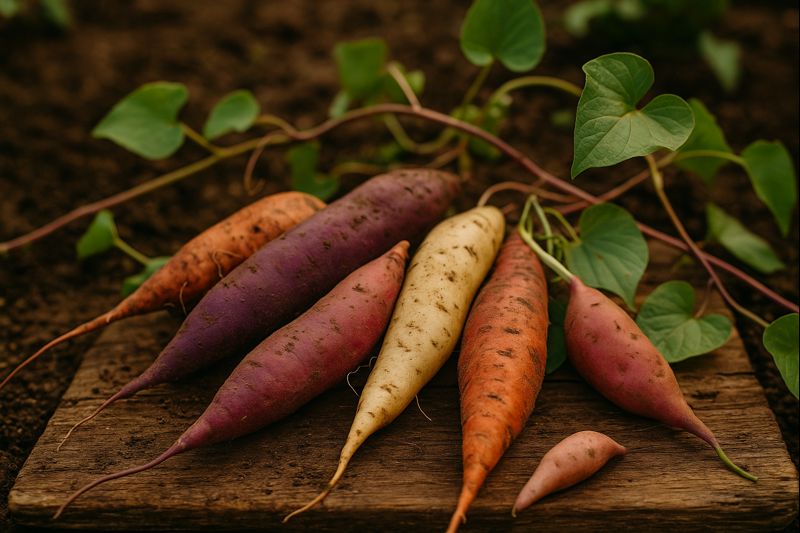
Sweet Potato
Ipomoea batatas
Family: Convolvulaceae
Sweet potatoes are warm-season root vegetables that produce nutritious, sweet-fleshed tubers in a range of colors from classic orange to purple, white, and red. Unlike regular potatoes (which are nightshades), sweet potatoes belong to the morning glory family and are grown from slips—rooted sprouts from mature tubers. They thrive in long, hot summers and are remarkably productive, with a single plant yielding 3-8 pounds of tubers.
Days to Harvest
90-120 days
Sun Needs
Full Sun (6+ hours)
moderate
Germination Temp
80°F optimal
Start Indoors
0 weeks before last frost
Germination
7-14 days
Seed Depth
Slips planted 4 inches deep
Light to Germinate
Yes
💡 Tip: Sweet potatoes are grown from slips (rooted sprouts), not seeds. Start sprouting sweet potatoes in water or soil 8-12 weeks before planting. Plant slips when soil temperature reaches 65°F.
Soil Type
Sandy loam, well-drained, loose soil
pH Range
5.8 - 6.2
Spacing
12-18 inches between plants, 36-48 inches between rows
⚠️ Avoid planting near:
History
Sweet potatoes originated in Central or South America over 5,000 years ago, making them one of the oldest domesticated vegetables in the Americas. Archaeological evidence from Peruvian caves dates sweet potato cultivation to at least 2500 BCE, though wild forms were likely consumed much earlier. The Inca and Maya civilizations cultivated numerous varieties, and sweet potatoes spread throughout the Pacific Islands long before European contact—one of the great mysteries of agricultural history. Polynesian voyagers somehow obtained sweet potatoes from South America and carried them across the Pacific, where the tuber became a staple crop in Hawaii, New Zealand (where Maori called it "kumara"), and other Pacific islands centuries before Columbus. Spanish explorers brought sweet potatoes to Europe in the late 15th century, and Portuguese traders introduced them to Africa, India, and Southeast Asia in the 16th century. Henry VIII of England reportedly enjoyed sweet potato pie, and the tubers were considered an aphrodisiac in Elizabethan times—Shakespeare references them in "The Merry Wives of Windsor." In colonial America, sweet potatoes became essential to Southern cuisine, particularly among enslaved Africans who found the tubers similar to African yams. George Washington Carver championed sweet potatoes in the early 20th century, developing over 100 products from them to help Southern farmers diversify beyond cotton. The orange-fleshed variety we commonly see today was marketed as "yams" in the 1930s to distinguish them from drier, white-fleshed varieties, creating lasting confusion between true yams (Dioscorea species from Africa) and sweet potatoes. Japan embraced sweet potatoes so thoroughly that they became a wartime survival food, and today Japanese sweet potatoes (Satsumaimo) with purple skin and yellow flesh are prized for their chestnut-like flavor. China now produces over 70% of the world's sweet potatoes, using them for food, animal feed, and industrial starch. In the United States, North Carolina leads production, and the sweet potato was designated the official state vegetable of North Carolina in 1995. NASA has studied sweet potatoes as an ideal crop for space missions due to their nutritional density, high yield, and edible leaves. The purple sweet potato, rich in anthocyanins, has gained popularity for its antioxidant properties and striking color that persists through cooking. From ancient Peruvian farmers to modern space scientists, sweet potatoes have proven their worth as one of humanity's most valuable and versatile crops.
Nutritional Benefits
- ✓Extremely high in beta-carotene (Vitamin A)
- ✓Excellent source of fiber
- ✓Rich in Vitamin C