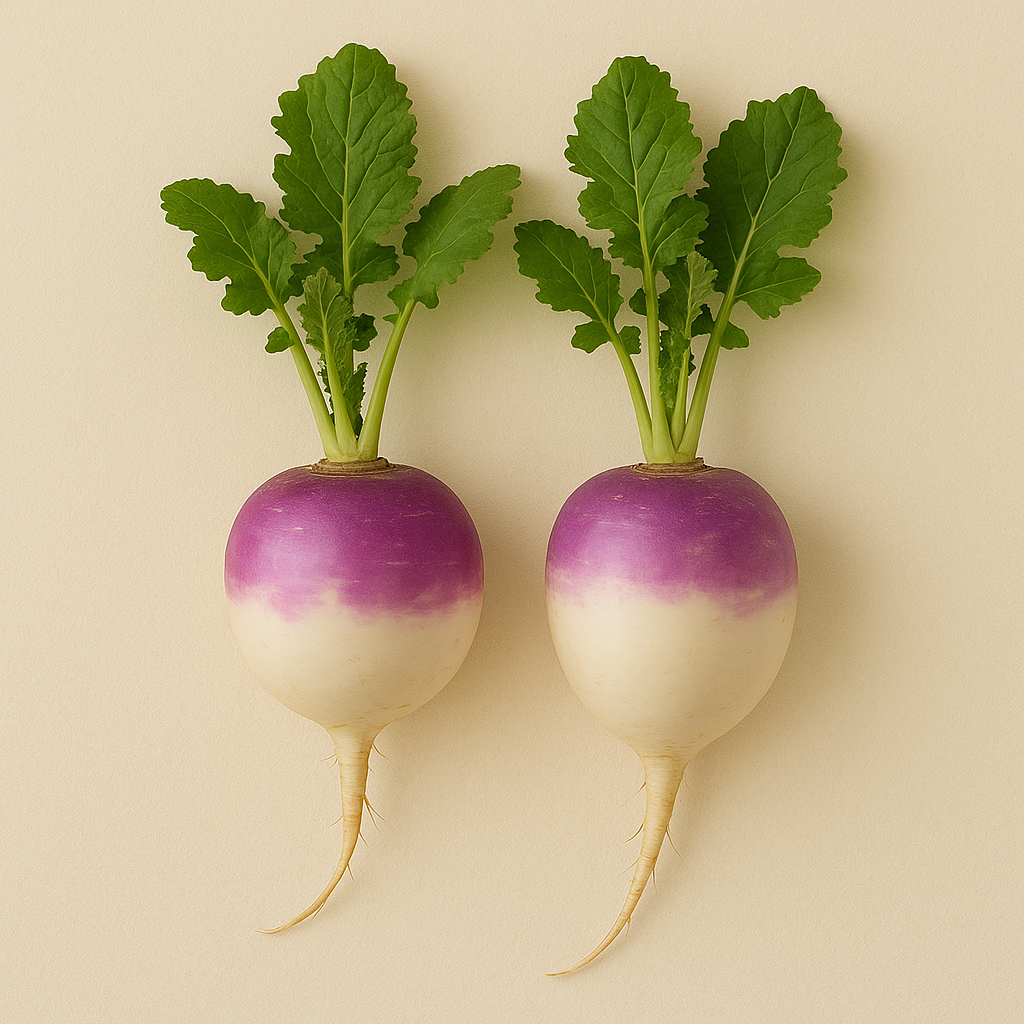
Turnips
Brassica rapa subsp. rapa
Family: Brassicaceae
Turnips are fast-growing root vegetables providing both tasty roots and nutritious greens. The white or purple-topped roots have a mild, slightly sweet flavor when harvested young. Often overlooked, turnips deserve a place in every garden.
Days to Harvest
35-60 days
Sun Needs
Full Sun to Partial Shade (4-6 hours)
moderate
Germination Temp
65°F optimal
Start Indoors
0 weeks before last frost
Germination
3-7 days
Seed Depth
1/4 to 1/2 inch
Light to Germinate
No
💡 Tip: Direct sow only. Can be planted in spring and again in late summer for fall harvest. Fall crop is sweeter.
Soil Type
Loose, well-draining soil
pH Range
6 - 7.5
Spacing
4-6 inches between plants, 12-18 inches between rows
⚠️ Avoid planting near:
History
Before potatoes conquered Europe, turnips reigned supreme as the humble sustenance of peasants, livestock, and even kings—a 4,000-year history that spans from ancient Persia to the highlands of Scotland. The turnip's origins remain debated, with some botanists pointing to Central Asia or Siberia and others to the Mediterranean, but wild turnips (Brassica rapa) have been gathered since prehistoric times. Ancient Greek and Roman writers mentioned turnips extensively; Pliny described both round and flat varieties, and the vegetable appeared in Apicius's Roman cookbook. When the Roman Empire fell, turnips became the survival food of medieval Europe, providing both food for humans and fodder for livestock through harsh winters. In Scotland and Ireland, turnips were integral to Celtic celebration of Samhain—the original jack-o'-lanterns were carved from turnips before Irish immigrants discovered America's larger, easier-to-carve pumpkins. The expression "blood from a turnip" dates to the 17th century, reflecting the vegetable's association with poverty and bare sustenance. The "Turnip Winter" of 1916-1917 in Germany saw the root vegetable become practically the only food available as wartime blockades cut off other supplies—an estimated 700,000 Germans died from starvation and disease. Japanese hakurei turnips, developed in the 20th century, revolutionized how Western palates perceive turnips, offering a sweet, mild flavor suitable for raw eating. Southern American cuisine embraced turnip greens as much as the roots, slow-cooked with smoked ham hock as soul food. Today, turnips are experiencing a culinary renaissance as chefs rediscover heirloom varieties and showcase their sweet, mild flavor when harvested young—a far cry from the tough, bitter roots of historical necessity.
Nutritional Benefits
- ✓Low in calories
- ✓Good source of Vitamin C
- ✓Contains fiber
Optimal Growing Temp
50°F - 65°F
Turnips grow best in cool weather between 50-65°F. Frost improves sweetness. Heat causes woody, bitter roots.
Survival Range
25°F - 80°F
Can survive these temperatures
Frost Note: Turnips tolerate frost down to 20-25°F. Light frost sweetens the roots. Can overwinter in mild climates with mulch.
Best USDA Zones
Humidity
50-70%
Moderate humidity is fine. Excessive moisture can promote fungal issues.
Height
12-18 inches
Spread
6-8 inches
Growth Habit
rosette
Germination
3-10 days
Turnip seeds germinate quickly—as fast as 3 days in warm soil. First seed leaves (cotyledons) emerge.
Seedling Stage
Duration: 2-3 weeks
True leaves: First true leaves are slightly fuzzy and broader than seed leaves
Transplant ready: Turnips should be direct sown—they don't transplant well due to taproot.
Vegetative Growth
Duration: 4-8 weeks depending on variety
Plants produce nutritious greens while the root swells underground. Both are edible.
Harvest Maturity
Timing: 30-60 days from seed depending on variety
- Root shoulders visible at soil line (1-3 inches diameter)
- Roots are firm when gently squeezed
- Harvest before roots become woody
- Smaller roots (2-3 inches) are most tender
Per Plant
1 root per plant (4-12 oz) plus edible greens
Per Square Foot
9 turnips per square foot with 4-inch spacing
Harvest Frequency
Harvest as needed once roots reach usable size
Factors Affecting Yield
- •Variety selection—early varieties for fast harvest, storage types for larger roots
- •Growing temperature—heat causes woody, bitter roots
- •Consistent moisture for tender texture
- •Thinning—crowded turnips stay small
Seedling Stage
Keep soil consistently moist for quick germination
Established Plants
About 1 inch per week for tender roots
During Fruiting
Maintain consistent moisture—irregular watering causes cracking
Preferred Method
Drip irrigation or soaker hoses. Avoid overhead watering which promotes disease.
⚠️ Critical Watering Periods
- • Root development phase
Pro Tips
- Consistent moisture is key for tender, mild flavor
- Mulch to maintain even soil moisture
- Water stress causes woody, bitter roots
Feeding Schedule
Soil preparation
Compost worked into soil
Once before planting
Growing
Side-dress with compost if needed
Once at 3-4 weeks if growth is slow
Organic Options
Work compost into soil before planting. Avoid fresh manure which causes forked roots.
Minimum Size
8 inches deep, 12-inch diameter
Recommended Size
10-12 inches deep for full-size turnips
Depth Required
At least 8 inches for globe varieties
Best Varieties for Containers
Container Tips
- Use well-draining potting mix
- Space 3-4 inches apart
- Keep consistently moist
- Harvest when small for best flavor
Plant Every
Every 2-3 weeks
Sowings/Season
4-6 plantings
Duration
Spring through fall (skip hot midsummer)
Tips
- Plant in early spring and again in late summer for fall harvest
- Fall plantings produce sweeter roots
- Skip midsummer when temperatures exceed 80°F